Murder on Baker Street
On the evening of the 26th of February 1993, London’s iconic Baker Street—made famous by Sir Arthur Conan Doyle’s Sherlock Holmes novels—became the scene of a non-fictional murder. Inside his luxury penthouse, 38-year-old Ruslan Outsiev, a top aide to Chechen president Dzhokhar Dudayev, lay dead, executed by three shots to the head. Two days later his 20-year-old brother Nazarbek was killed in a similar style. What was first understood as a criminal operation quickly unravelled into a sinister political plot embroiling the British military establishment, the KGB, the war in Artsakh and Chechnya’s ultimately doomed hopes for independence.
Background: The Outsiev Brothers & a Breakaway Chechen State
Following the collapse of the USSR Chechnya sought recognition as an independent republic. Chechan officials were issuing passports, banknotes, and trying to secure external financing for its oil infrastructure. Part of their overseas operations were led by two trusted members of Chechnya’s elite, the Outsiev brothers:
- Ruslan Outsiev: A close ally of Dudayev, referred to as a “hardline enforcer”—charismatic, populist, feared. He served as vice president of the Supreme Presidential Council. In London he posed as Chechnya’s prime minister, where he enjoyed the best the City had to offer: expensive restaurants, a flat worth ~£1 million and London’s lavish nightlife where he was known for keeping company with a dazzling array of escorts.
- Nazarbek Outsiev: A young martial artist studying English Literature. His real role? Both his brother’s bodyguard and an enforcer in foreign negotiations
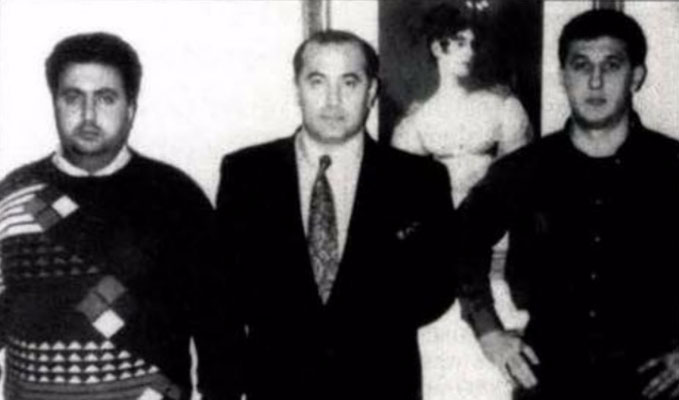
Gagik Ter-Oganisyan (on the left) and Outsiev brothers
Their role was to wine and dine London’s rich and powerful, to show them what a 21st Century Chechnya could be, and secure key deals to ensure Chechnya’s future. Amongst their projections they were pursuing a $250 million development loan as well as an oil deal with Germany’s Stinnes AG. These ambitious economic undertakings had a sinister underbelly—the Outsiev’s were looking to covertly acquire 2,000 U.S. made Stinger surface-to-air missiles.
Under the pretense of diplomatic and commercial visits Russlan established negotiations while Nazarbek used his cover as a university student to provide protection and coordinate their operations. They were keen on showcasing Chechnya as an independent actor capable of self-governance and deserving of nationhood. Their negotiation venues included London’s famous Langham Hotel amongst other private meeting rooms.
The needle: US made stinger missiles|—costing around $100K each, the brothers were hoping to secure a staggering $200 million arms deal that could significantly empower Chechniya, and its close ally in the region Azerbaijan in the ongoing Nagorno-Karabakh conflict. For Armenia such a procurement was existentially dangerous.
Betrayal from Within: The Role of Gagik Ter‑Oganisyan
To coordinate negotiations Ruslan brought on Gagik Ter‑Oganisyan, the husband of BBC producer Alison Ponting. Originally from Armenia, Ter‑Oganisyan had moved to the UK in 1988, working first as a swimming pool attendant, later as a small-scale exporter. He became the brothers’ translator and aide-accessory—accompanying them to meetings, setting agendas, and overseeing logistics.
Upon discovering the brother’s real intentions Ter‑Oganisyan was plunged into a moral crisis. Chechnya’s close relationship with Azerbaijan meant there was a significant likelihood that these missiles would be used against Armenians fighting for the freedom of Artsakh. He chose to make a report to Mkrtich Martirosyan, a KGB operative within the Armenian diaspora network and a key player in Armenia’s national security aparatus.
Armenian Plot Unleashed: Martirosyan & Sargsyan Arrive in London
Realising the severity of the situation, Armenia’s security services mobilized. Martirosyan entered the UK under cover, posing as a “trade official,” accompanied by alleged KGB officer Ashot Sargsyan, who portrayed himself as an Armenian Chamber of Commerce representative. Their mission: begin intelligence gathering, issue threats, attempt to dissuade Ruslan, or—if it was neccessary—execute a kill directive.
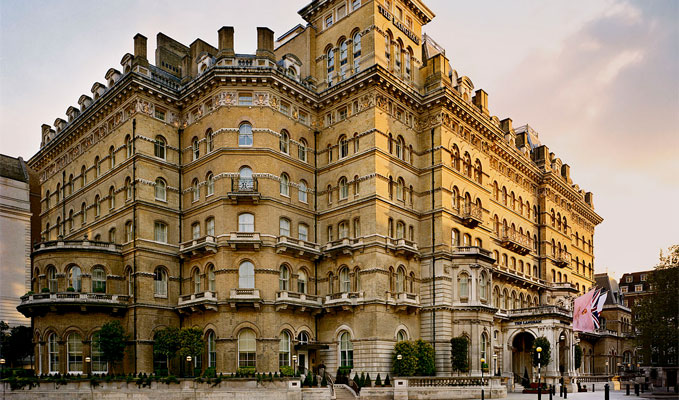
Langham Hotel in London
On 20 February, Martirosyan confronted Outsiev at the Langham. Ter‑Oganisyan was present. They argued, but Outsiev refused to abandon the missile deal, they believed that the future of a fledgling Chechnyan state depended on it. His refusal sealed his and his brother’s fates. Martirosyan attempted to hire an assassin through the Armenian diaspora in Los Angeles—but the hitman, one Ashot (Arthur) Detmenjian, suffered visa delays and never arrived. Undeterred, the men moved the plot forward.
Murder in Two Acts: The Outsiev Assassinations
On 26 February, Ruslan was executed in his Baker Street flat: three shots to the head, assassination-style. Police later determined it was a professional hit.
Two days afterwards—28 February—Nazarbek was killed upon his exit from a hospital procedure. The investigation indicated the second killing was intended to remove any chance of retaliation or loose ends.
Cover-Up Attempt & Arrests in London
The perpetrators arranged to hide the bodies: Ruslan was placed in a fridge packaged as a “17th-century statue,” and delivery personnel were hired. When the stench and leaked fluids raised alarms, authorities were notified. Police arrived at a suburban London address and the Baker Street flat, finding Ter‑Oganisyan and Martirosyan armed, with makeshift dismemberment tools and a firearm.
Alison Ponting was arrested—but released within 24 hours after proving ignorance of the plot.
Legal Proceedings & Exposure of a Political Murder
Mkrtich Martirosyan confessed during interrogation, revealing state involvement and naming Sargsyan as issuing orders. A vial of snake venom—allegedly for suicide—was found hidden on him. Another vial was found near Ter‑Oganisyan’s home. While awaiting trial in Belmarsh Prison, Martirosyan committed suicide, reportedly by using his venom vial.
Gagik Ter‑Oganisyan stood trial at London’s Old Bailey in October 1993. The prosecution portrayed the killings as a “state-sponsored political assassination”—a stark deviation from typical gangland hits. They failed to proved he pulled the trigger, but found his involvement in logistics and planning irrefutable. His sentence was life imprisonment.
Ashot Sargsyan fled the UK. A few months later his body was found in Moscow under suspicious circumstances— whether the Outsiev’s were avenged remains unclear.
Collateral Killings: Revenge Aftermath
In April 1994, Alison’s sister, Karen Reed, was fatally shot in Woking. Investigators surmised that Alison was the intended target—her sister’s death a tragic instance of misidentification. A detective on the case described it as a calculated attack with extensive reconnaissance and silencer-equipped firearms. Karen’s murder remains officially unsolved.
References & Sources
- PanARMENIAN.Net – “How Chechens selling arms to Azeris were killed in London”
https://panarmenian.net/eng/details/225929/ - The Independent – “Armenian jailed for London KGB killings…”
https://www.independent.co.uk/news/uk/armenian-jailed-for-london-kgb-killings-arms-deal-led-to-deaths-of-brothers-from-rebel-russian-republic-in-luxury-flat-1512278.html - The Independent – “KGB hitman shot brothers…”
https://www.independent.co.uk/news/uk/kgb-hitman-shot-brothers-murder-trial-told-of-contract-killings-1511714.html - Seattle Times – “Stinger missiles aplenty despite CIA buyback”
https://archive.seattletimes.com/archive/?date=19931122&slug=1733233 - UPI – “UK police guard assassin’s target” (Karen Reed case)
https://www.upi.com/Archives/1994/05/02/UK-police-guard-assassins-target/4319767851200/ - Gagrule.net – “How Chechens selling arms to Azeris were killed in London”
https://gagrule.net/how-chechens-selling-arms-to-azeris-were-killed-in-london/