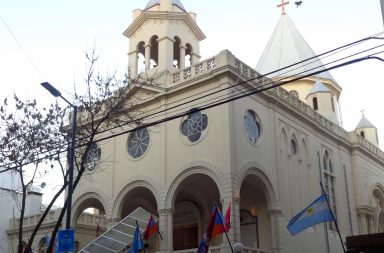
On February 17, bishops of the Armenian Apostolic Church convened in St. Pölten, Austria. Twenty-five archbishops and bishops of the Catholicosate of All Armenians are participating, along with representatives of the Armenian Patriarchates of Jerusalem and Constantinople. The decision to convene in Austria reflects the current constraints facing the Church’s leadership within Armenia.
The meeting had originally been intended as a formal Assembly of Bishops, the Church’s highest canonical deliberative authority. It is proceeding instead as a “Gathering,” because travel bans imposed by Pashinyan and his government on five high-ranking clergy and the Catholicos himself, together with the continued detention of four senior hierarchs, made the free convocation of the full episcopate impossible. The Assembly had been expected to address the arrests of senior clergy, the campaign against the Catholicos, and the widening internal divisions within the hierarchy.
Catholicos of All Armenians Karekin II addressed the participants online rather than in person. Messages were also delivered by Aram I of the Great House of Cilicia and the Armenian Patriarchs of Jerusalem and Constantinople.
The Gathering takes place against the backdrop of an escalating political confrontation initiated by Pashinyan and advanced through the institutions of his government. Following the “Tavush for the Homeland” movement and public criticism from senior clergy, he openly challenged the legitimacy of the Catholicos, repeatedly referred to him by his given name rather than his ecclesiastical title, and called for his resignation. He subsequently introduced what he termed “church reforms,” presenting them as institutional renewal while intervening directly in ecclesiastical affairs. Officials, ruling party deputies, and aligned public voices promoted this “church reforms” agenda, portraying the existing leadership as illegitimate and in need of restructuring.
The standoff moved beyond rhetoric when investigative bodies operating under his administration opened criminal proceedings against prominent clergy. More than two dozen individuals are widely regarded by Church supporters as political prisoners, including Archbishops Bagrat Galstanyan, Mikael Ajapahyan, Arshak Khachatryan, and Bishop Mkrtich Proshyan. At the same time, ten high-ranking clergymen aligned themselves with the reform agenda advanced by Pashinyan, met with him, and publicly advocated for the resignation of the Catholicos, deepening divisions within the episcopate.
The St. Pölten meeting therefore proceeds in reduced form, as several senior hierarchs remain imprisoned or legally constrained under measures enacted by Pashinyan and his government.