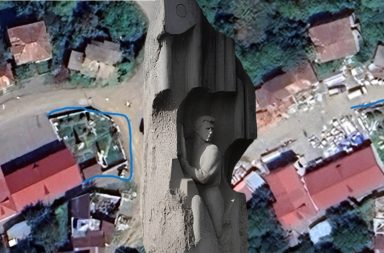
A historic Armenian church in Eozerli village, near Chork-Marzban in present-day Turkey’s Hatay Province, is at risk of disappearing after decades of neglect and deterioration, according to Ermenihaber.am.
The surviving structure is believed to be the Surp Krikor Lusavorich (St. Gregory the Illuminator) Church, built in Eozerli in 1877. Records of the Armenian Patriarchate of Constantinople list the church among the Armenian religious sites of Chork-Marzban and its surrounding villages.
In the late 19th century, Eozerli was a thriving settlement of roughly 300 households, including around 250 Armenian and 50 Muslim families. The village had an Armenian church, a school, a market and other community institutions.
That Armenian presence was shattered during the Armenian Genocide and the upheavals that followed. Armenians from Chork-Marzban and surrounding settlements were subjected to deportation, displacement and mass violence in 1915. Some survivors later returned to Cilicia, but the remaining Armenian population was ultimately forced to leave the region following the French withdrawal from Cilicia in the early 1920s.
More than a century later, the church that once served Eozerli’s Armenian community remains standing, but in severely deteriorated condition.
Its original roof has collapsed and has been replaced with a makeshift wooden structure covered with tiles. The windows have been sealed with concrete blocks, the walls have been altered and damaged, and the historic inscription above the main entrance has been removed.
For years, the building was reportedly used as a stable and as a shelter for goats, causing further damage to the structure.
Preservation efforts are also complicated by uncertainty over the church’s ownership and legal status. In cadastral records, the property is reportedly listed simply as a “ruined building and land parcel,” rather than as a historic or religious monument.
Without formal recognition and a clear ownership status, restoration or conservation work becomes significantly more difficult, while the structure continues to deteriorate.
The remains of Surp Krikor Lusavorich Church are among the few surviving traces of the Armenian community that once formed the overwhelming majority of Eozerli’s population. With each passing year of neglect, another physical record of the centuries-old Armenian presence in Chork-Marzban and Cilicia moves closer to irreversible loss.