by Khoren Movses
The participation of dozens of foreign diplomats in Azerbaijan’s state organized tour of Artsakh deserves condemnation and serious scrutiny. These are not ordinary tourists unknowingly entering a political event. They are official representatives of governments and international institutions, and every photograph, visit, public gesture and every silence carries diplomatic weight.
Among the publicly identified participants are U.S. Chargé d’Affaires Amy Carlon, French Ambassador Sophie Lagoutte, British Ambassador Duncan Norman, EU Special Representative for the South Caucasus Magdalena Grono, Mexican Ambassador María Victoria Romero Caballero, Pakistani Ambassador Qasim Mohiuddin, Indonesian Ambassador Berlian Helmy, Uzbek Ambassador Bahrom Ashrafkhanov and Kyrgyz Ambassador Maksat Mamytkanov. The delegation is being accompanied by Azerbaijani presidential aide Hikmet Hajiyev.
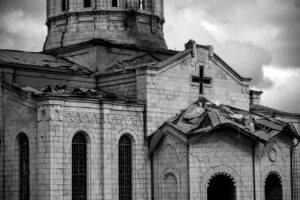
Their participation is especially troubling because Azerbaijan is not merely showcasing reconstruction projects. The diplomats are being taken to ancient Armenian Christian monuments while their Azerbaijani hosts publicly present sites such as Gandzasar through the state promoted “Caucasian Albanian” narrative, seeking to detach them from their documented Armenian history and identity.
Gandzasar is not a monument of uncertain origin. The 13th century monastery contains extensive Armenian inscriptions and has centuries of documented association with the Armenian Apostolic Church and the Armenian population of Artsakh. Dadivank likewise possesses a substantial Armenian ecclesiastical and epigraphic record.
Foreign diplomats who participate in an official tour where these monuments are presented under another identity risk lending their offices, countries and international standing to Azerbaijan’s campaign of historical revisionism.
Silence in this context is not neutrality. When accredited diplomats are brought to centuries old Armenian religious monuments, witness those monuments being presented through narratives that erase or diminish their Armenian identity, and offer no public correction or acknowledgment of their documented history, their silence carries consequences. It helps normalize the very narrative Azerbaijan is seeking to establish.
Diplomats understand the symbolic power of their presence. If they stand inside Armenian monasteries while their hosts strip the word “Armenian” from their history, pose for photographs and move on without objection, they cannot pretend that their presence exists in a political vacuum. Silence under such circumstances risks becoming complicity in the normalization of historical revisionism.
The problem extends far beyond cultural heritage.
In Stepanakert, members of the diplomatic delegation visited Azerbaijan’s so called “Victory Park” and posed for a commemorative photograph. The imagery of a newly constructed park cannot be separated from the fate of the population that lived there.
In September 2023, virtually the entire Armenian population of Artsakh, more than 100,000 people, fled following Azerbaijan’s military offensive. Stepanakert, an overwhelmingly Armenian city before the exodus, was emptied of its Armenian residents.
For displaced residents whose homes and neighborhoods once stood in areas now being transformed by Azerbaijan, photographs of foreign diplomats celebrating or legitimizing the new reality are anything but politically neutral.
The silence surrounding their displacement is therefore just as troubling as the photographs themselves.
Foreign representatives cannot pose at a state constructed “Victory Park,” against the backdrop of a city emptied of its Armenian population, without acknowledging the people who were forced to leave. By participating in a carefully orchestrated presentation of the post 2023 reality while remaining publicly silent about those who were displaced, diplomats risk becoming complicit in the whitewashing and normalization of what happened.
Amy Carlon of the United States, Sophie Lagoutte of France, Duncan Norman of the United Kingdom and Magdalena Grono of the European Union should not allow themselves to become symbols of international acceptance of a post 2023 Artsakh in which the Armenian population has disappeared while its cultural heritage is progressively reinterpreted.
The same responsibility belongs to María Victoria Romero Caballero of Mexico, Qasim Mohiuddin of Pakistan, Berlian Helmy of Indonesia, Bahrom Ashrafkhanov of Uzbekistan and Maksat Mamytkanov of Kyrgyzstan.
Their presence does not prove that each diplomat personally accepts Azerbaijan’s historical claims or endorses every narrative presented during the tour. But that distinction does not eliminate their responsibility for the political significance of participating in a carefully organized government visit.
Diplomats have agency.
They can publicly acknowledge the Armenian history of the monuments they visit. They can insist upon the preservation of Armenian inscriptions, khachkars, cemeteries and churches. They can support independent international monitoring of cultural heritage. They can meet displaced Artsakh Armenians. They can publicly raise the issue of Armenians detained in Azerbaijan.
When they choose instead to participate in a government organized tour, appear in the photographs and remain silent about the Armenian history and population being removed from the narrative, that silence becomes part of the political message.
Their responsibility is equally significant in Shushi, where Armenian religious and cultural heritage has faced destruction and alteration during periods of conflict and Azerbaijani control. A tour showcasing reconstructed streets while ignoring the Armenian churches, museums, cemeteries and communities that formed part of the city’s history presents an incomplete and politically useful version of the past.
Again, silence matters. Visiting Shushi without acknowledging its Armenian cultural heritage allows Azerbaijan to present reconstruction without reckoning with what has been destroyed, altered or erased.
The participation of representatives from the United States and France carries additional significance because both countries spent decades serving as Co Chairs of the OSCE Minsk Group and were directly involved in negotiations over the Nagorno Karabakh conflict. The European Union, represented on this trip by Magdalena Grono, has likewise assumed a major diplomatic role in Armenia Azerbaijan relations.
These governments and institutions are fully aware of the history of the conflict, the displacement of Artsakh’s Armenian population and the continuing dispute surrounding Armenian cultural heritage under Azerbaijani control. Their representatives therefore cannot credibly treat such visits as ordinary diplomatic tourism.
Nor can they separate their physical presence from the propaganda value Azerbaijan derives from it.
Images of American, French, British, European and other diplomats touring these sites can be presented domestically and internationally as evidence of acceptance: acceptance of Azerbaijan’s historical narrative, acceptance of its portrayal of the 2023 outcome and acceptance of an Artsakh emptied of its indigenous Armenian population.
That is precisely why public acknowledgment matters.
Foreign governments cannot repeatedly invoke human rights, cultural preservation and international law while allowing their representatives to become scenery in a state organized presentation of the aftermath of mass displacement as a story solely of “victory” and reconstruction.
The diplomats participating in this visit should be held publicly accountable, not because diplomatic engagement with Azerbaijan itself is illegitimate, but because engagement should not come at the expense of historical truth or the memory and rights of the people who were displaced.
Visiting Stepanakert carries a responsibility to acknowledge its displaced Armenian residents.
Visiting Gandzasar and Dadivank carries a responsibility to acknowledge their Armenian history.
Visiting Shushi carries a responsibility to acknowledge its Armenian cultural heritage and what has been destroyed, altered or lost.
And participating in a state organized tour of Artsakh carries a responsibility not to become part of a narrative that presents a land emptied of its Armenian population as little more than a diplomatic sightseeing destination.
A just peace cannot be built on the oblivion of the displaced, silence about detainees or the stripping of cultural monuments of their historical identity. Nor can reconciliation be achieved by asking the international community to admire reconstruction while ignoring the people who are no longer permitted to live there.
The diplomats who participated in this tour still have an opportunity to demonstrate that their presence does not equal endorsement. They can speak publicly about what they saw, acknowledge the Armenian history of the monuments they visited, raise the fate of the displaced population and Armenian detainees, and demand genuine international access to endangered cultural heritage.
But remaining silent while their photographs and offices are used to legitimize Azerbaijan’s preferred narrative is itself a choice.
Ethnic cleansing must not be transformed into a diplomatic tourist itinerary. When foreign diplomats lend their presence to the whitewashing of its consequences while remaining silent about the people and history being erased, that silence becomes complicity in its normalization.