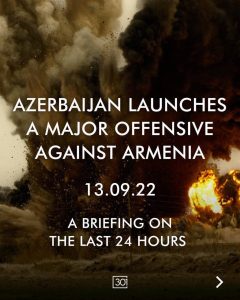
On September 13, 2022, Azerbaijan launched a large-scale offensive against Armenia, marking the most serious escalation since the 2020 Artsakh War and pushing Azerbaijani forces deeper into Armenia’s sovereign territory.
The attack followed repeated statements by Ilham Aliyev concerning the so-called “Zangezur Corridor” and previous Azerbaijani incursions into Armenia beginning in 2021.
At 00:05 local time on September 13, Armenia’s Defense Ministry issued its first public statement, reporting that Azerbaijani forces had begun intensive shelling of Armenian positions in several directions with artillery, large-caliber weapons and other firepower.
Azerbaijani forces attacked across several sections of Armenia’s eastern border.
In Gegharkunik, they attacked in the directions of Vardenis, Sotk, Kut and Geghamasar. In Vayots Dzor, Azerbaijani forces attacked toward Jermuk. In Syunik, they attacked around Mets Ishkhanasar, Kapan and Goris.
They used artillery, mortars, drones and other weapons against military positions and civilian infrastructure.
The attacks also struck Armenian towns and villages far beyond military positions.
Armenian authorities reported attacks affecting 36 settlements. The fighting damaged or destroyed nearly 200 homes, as well as schools, a medical facility, hotels, electricity and water infrastructure, gas pipelines, roads and other civilian facilities. Azerbaijani forces also targeted ambulances.
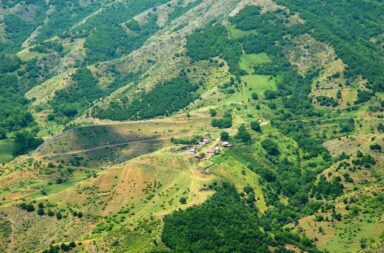
Jermuk, one of Armenia’s best-known resort towns, came under attack as fighting reached the surrounding area. Azerbaijani forces used artillery, mortars and drones in the Jermuk direction during the two days of fighting.
At least three Armenian civilians were killed, while more than 7,600 people, mostly women and children, temporarily fled their homes because of the fighting.
The September offensive was not Azerbaijan’s first incursion into Armenia.
Following the 2020 Artsakh War, Azerbaijani forces had already crossed into internationally recognized Armenian territory. During the May 2021 incursions, they established positions around Black Lake, Mets Ishkhanasar and parts of Gegharkunik.
The September 2022 attack expanded that occupation.
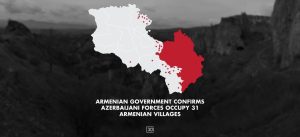
Estimates have placed the total area of Armenian territory under Azerbaijani control following the 2021 and 2022 incursions at approximately 220 square kilometers.
The occupied areas have been estimated to include roughly 74 square kilometers near Jermuk, 68 square kilometers in the Vardenis area, 23 square kilometers near Nerkin Hand, 20 square kilometers around Tskhuk and Ukhtasar, 16 square kilometers around Black Lake and Ishkhanasar, 12 square kilometers near Tsitsernakatar and approximately eight square kilometers near Kakhakn.
As the attack unfolded, Armenia appealed to the Collective Security Treaty Organization, seeking action in response to the attack on its sovereign territory.
After nearly two days of fighting, a ceasefire took effect at 20:00 on September 14. An earlier attempt to halt the fighting had failed.
The human cost was severe.
Armenia’s Investigative Committee later reported that the September 13 and 14 offensive killed 224 Armenian servicemen and civilians. The fighting wounded another 293 servicemen, while Azerbaijani forces captured 20 Armenian servicemen. Three servicemen remained missing as of December 2022.
Four years later, the authorities have still not publicly released a complete official list of those killed.
But September 2022 is remembered not only for the scale of the attack or the territory Azerbaijan occupied.
Some of the most disturbing evidence from those days came from videos that people filmed during and after the fighting and circulated online.
Footage showed Azerbaijani forces executing captured Armenian servicemen at close range.
Human Rights Watch later authenticated one video showing the apparent extrajudicial execution of at least seven Armenian prisoners of war by Azerbaijani forces. HRW analyzed the footage alongside satellite imagery from the Mets Ishkhanasar area and said the apparent execution constituted a war crime that required investigation and accountability.
Other videos and photographs showed Azerbaijani forces subjecting Armenian servicemen to mutilation, humiliation and degrading treatment.
Among the most widely documented cases was Armenian servicewoman Anush Apetyan. Footage circulated online showed her stripped and mutilated body. Evidence collected at the time also indicated that Azerbaijani forces had killed other Armenian female servicemembers and that someone had filmed the mutilated body of at least one other woman.
The evidence extended beyond individual videos.
Armenia’s Investigative Committee later documented alleged serious violations against more than 20 Armenian servicemen who held prisoner-of-war status, including torture, humiliation and inhuman treatment.
The significance of the footage lay not only in what it documented, but in how openly people recorded and circulated the crimes and their aftermath.
People present at the scenes filmed some of the footage and later spread it across social media.
International outrage followed.
Azerbaijan announced investigations into videos depicting executions, abuse and mutilation. Yet those investigations produced little visible accountability.
By the end of 2022, Amnesty International reported no progress in identifying those responsible for executing the Armenian prisoners shown in the footage.
Years later, Azerbaijan has still provided no transparent public accounting that demonstrates meaningful justice for these crimes.
Announcing an investigation does not establish its credibility. Authorities must publish transparent findings, identify and prosecute perpetrators, and examine responsibility through the chain of command where the evidence warrants it. Without those steps, such investigations provide no meaningful answer to the crimes documented on video.
The evidence has not disappeared.
Some Armenian servicemen died in battle.
Azerbaijani forces captured others, executed them, mutilated their bodies or subjected them to humiliation.
People filmed some of those crimes and posted the footage online.
The September 2022 offensive also forms part of a much longer history of occupation and displacement.
Azerbaijan has occupied Artsvashen since 1992.
Beginning in 2021, Azerbaijani forces crossed Armenia’s internationally recognized borders and established positions inside the Republic of Armenia.
In September 2022, another large-scale attack pushed Azerbaijani forces farther into Armenian sovereign territory.
Then came Artsakh.
After months of blockade, Azerbaijan launched another military offensive in September 2023. The attack and its aftermath forced more than 100,000 Armenians to flee Artsakh.
For the first time in centuries, Artsakh was left virtually without its indigenous Armenian population.
From Artsvashen to the territories Azerbaijan occupies in Gegharkunik, Vayots Dzor and Syunik, and from Stepanakert to Shushi and the rest of occupied Artsakh, the red areas on the map represent far more than territorial changes.
They represent Armenian communities emptied of their populations.
They represent abandoned homes, lost villages, churches, cemeteries and schools.
They represent generations of Armenians separated from lands where their families had lived.
Behind every territorial loss are people who fought, died, fled their homes, were taken prisoner or continue to wait for the possibility of return.
Four years after the September 2022 attack, Azerbaijani positions inside Armenia remain a reminder that the consequences of those two days did not end when the fighting stopped.
Nor did the crimes documented on video disappear when international attention moved elsewhere.
Armenian servicemen fighting in September 2022 stopped a further Azerbaijani advance, including toward Jermuk. Many of them never returned home.
Their sacrifice deserves more than an anniversary.
It demands remembrance.
It demands that Armenia fully document the circumstances of their deaths, preserve the names of the fallen, refuse to bury crimes against Armenian prisoners and servicemen beneath political expediency, and refuse to allow occupation to become normalized through the passage of time.
Borders can be altered on maps.
Silence can normalize occupation.
People can be driven from their homes.
But no one can simply erase the history of these lands, the crimes committed there or the memory of those who defended them.
Eternal honor to those who gave their lives defending Armenia on September 13 and 14, 2022.
Their courage, their names and their memory remain.
No one is forgotten.
Nothing is forgotten.