🇦🇲 Armenia Votes 2026
Armenians are heading to the polls today in one of the most consequential parliamentary elections in the country’s modern history.
The vote will determine the composition of Armenia’s next National Assembly and the government that will lead the nation through a defining period marked by the aftermath of the 2020 Artsakh War, the forced displacement of the Armenian population of Artsakh, ongoing negotiations with Azerbaijan, and growing debates over Armenia’s sovereignty, security, identity and national future.
This is the first regularly scheduled parliamentary election since 2017, following the political upheavals that led to snap elections in 2018 and 2021.
Today, Armenians are not only choosing their representatives, they are helping shape the direction of the Armenian state for years to come.
Live Updates
Note: The Central Electoral Commission’s most recent updates list 2,505,102 eligible voters and 2,005 polling stations nationwide. Earlier figures published by state authorities and election officials cited 2,485,851 eligible voters and 1,997 polling stations. The reason for the discrepancy has not yet been clarified publicly.
🇦🇲 Armenia Votes 2026 – Live Updates
11:00 a.m. | June 8
Preliminary Results of Armenia’s Parliamentary Elections
The Central Electoral Commission has published the preliminary results of Armenia’s parliamentary elections after processing 1,476,916 ballots nationwide.
Preliminary results:
▫️ “Civil Contract” Party — 727,160 votes (49.81%)
▫️ “Strong Armenia” Alliance — 340,062 votes (23.29%)
▫️ “Armenia” Alliance — 145,097 votes (9.94%)
▫️ “Prosperous Armenia” Party — 58,368 votes (4.00%)
Political parties and alliances that failed to meet the electoral threshold will not receive seats in parliament. Under Armenia’s electoral system, those votes are redistributed during the seat allocation process among the political forces that successfully entered the National Assembly.
Based on the preliminary results, the projected distribution of seats is:
▫️ “Civil Contract” Party — 61 seats
▫️ “Strong Armenia” Alliance — 28 seats
▫️ “Armenia” Alliance — 11 seats
▫️ “Prosperous Armenia” Party — 5 seats
The ruling Civil Contract Party is projected to retain its parliamentary majority and form the next government. However, with 61 seats, it falls short of the 70 seats required for a constitutional majority.
A total of 1,476,916 ballots were counted nationwide. Final certified results are expected following the completion of all legal and administrative procedures by the Central Electoral Commission.
8:00 a.m. | June 8
According to Armenia’s Central Electoral Commission, 1,394,682 ballots have been counted, representing approximately 94.4% of all votes cast nationwide.
Current results:
▫️ Civil Contract Party — 689,675 votes (50.04%)
▫️ Strong Armenia Alliance — 321,597 votes (23.33%)
▫️ Armenia Alliance — 135,808 votes (9.85%)
▫️ Prosperous Armenia Party — 54,900 votes (3.98%)
▫️ Wings of Unity Party — 31,465 votes (2.28%)
With more than 94% of ballots counted, Civil Contract remains on course to secure a parliamentary majority, while Strong Armenia and the Armenia Alliance are positioned to enter parliament.
At this stage of the count, no other political force has reached the electoral threshold required to gain representation in the National Assembly.
6:00 a.m. | June 8
The Central Electoral Commission has processed results from 1,222 of 2,006 polling stations, representing 756,439 ballots, or approximately 51.23% of all votes cast in Armenia’s parliamentary elections.
Current results:
▫️ Civil Contract Party — 381,706 votes (50.5%)
▫️ Strong Armenia Alliance — 173,168 votes (22.9%)
▫️ Armenia Alliance — 71,172 votes (9.4%)
▫️ Prosperous Armenia Party — 31,107 votes (4.1%)
▫️ Wings of Unity Party — 17,292 votes (2.3%)
According to the CEC, 747,101 valid votes and 9,339 invalid ballots have been recorded thus far.
With just over half of all ballots counted, the results remain preliminary as vote tabulation continues across the country.
4:00 a.m. | June 8
Strong Armenia Alliance leader Samvel Karapetyan issued an urgent statement rejecting claims that Armenia’s parliamentary election had already been decided.
Karapetyan stated that the election was not over and that final results were still unavailable, arguing that the ruling Civil Contract Party had prematurely declared victory.
He claimed that Civil Contract was presenting the election as decided based on roughly 30% of the vote count and argued that the published figures primarily reflected rural polling stations, while results from major urban centers had yet to be fully released.
“The elections are not over yet, and the final results are still not in,” Karapetyan said, insisting that the ruling party would not achieve the victory it expected.
Karapetyan also questioned the vote-counting process, arguing that there had never been a precedent for halting the publication of election results and announcing that additional results would be released the following morning.
He further claimed that the ruling party’s public appearances and interviews suggested that the election was not unfolding in its favor, asserting that Civil Contract had suffered what he described as a “humiliating defeat.”
Describing the election as “shameful,” Karapetyan stated that 75 members of his team had been arrested and claimed that more than 700 individuals had been detained overall during the election period.
3:00 a.m. | June 8
Opposition leaders strongly condemned Nikol Pashinyan’s declaration of victory, arguing that it was made long before the election results had been finalized and amounted to direct political pressure on the Central Electoral Commission.
Former Human Rights Defender Arman Tatoyan, Armenian Revolutionary Federation leader Ishkhan Saghatelyan, and Strong Armenia Alliance leader Samvel Karapetyan all criticized Pashinyan’s announcement, stressing that the election outcome can only be determined after all votes are counted and officially certified.
Tatoyan described Pashinyan’s declaration that Civil Contract had already won the election and would form a single-party government as unconstitutional. He noted that the statement was made while only a small fraction of ballots had been processed nationwide and while much of the vote from Yerevan remained uncounted.
According to Tatoyan, the prime minister has no legal authority to declare victory, determine the composition of the future government, or threaten political opponents with prosecution. He argued that Pashinyan’s remarks constituted an attempt to influence the Central Electoral Commission while vote counting was still underway.
“This constitutes illegal pressure on the Central Electoral Commission,” Tatoyan stated, warning that such actions could undermine confidence in the electoral process.
Ishkhan Saghatelyan, Chair of the ARF Supreme Council of Armenia and a leading figure in the Armenia Alliance, similarly accused Pashinyan of attempting to preempt the official results and pressure election authorities.
“Before the election results are summarized, your statements are simply attempts to pressure the CEC and seize power,” Saghatelyan said.
He argued that Pashinyan should first answer for the numerous alleged violations reported throughout Election Day rather than speak about future prosecutions and political retribution. Saghatelyan also noted that only a fraction of polling stations had been tabulated and that opposition forces were continuing to process protocols from across the country.
Strong Armenia Alliance leader Samvel Karapetyan likewise rejected Civil Contract’s victory claims, insisting that the election was far from over and that final results were still unknown.
Karapetyan argued that the ruling party was presenting the election as decided despite only a portion of votes having been counted. He claimed that the published figures largely reflected rural polling stations while results from major urban centers had yet to be fully released.
He also questioned the decision to halt the publication of results and continue the count into the morning, arguing that such a situation was unprecedented. Calling the election “shameful,” Karapetyan claimed that 75 members of his team had been arrested and that more than 700 individuals had been detained overall during the election period.
The coordinated criticism from opposition leaders highlighted growing concerns over the legitimacy of declaring victory while the overwhelming majority of ballots remained uncounted and official results had yet to be finalized.
2:30 a.m. | June 8
Prime Minister Nikol Pashinyan declared victory in Armenia’s parliamentary elections and announced that the ruling Civil Contract Party would form a single-party government and would not participate in any coalition.
The declaration came while the Central Electoral Commission had officially processed only 173,347 ballots, representing approximately 11.74% of the 1,476,697 votes cast nationwide. More than 1.3 million ballots remained uncounted at the time of his remarks.
Despite the count still being in its early stages and results from the overwhelming majority of polling stations yet to be published, including much of Yerevan, Pashinyan described the outcome as a “historic victory” and spoke as though the election had already been decided.
Speaking at Civil Contract’s headquarters, Pashinyan stated that voters had endorsed his government’s agenda and said the ruling party was on course to govern alone. He also reiterated that opposition leaders Robert Kocharyan, Gagik Tsarukyan and Samvel Karapetyan should be brought to justice and imprisoned, framing the election as a mandate to eliminate what he described as a criminal-oligarchic system.
Pashinyan further stated that Armenia would continue pursuing closer ties with the European Union while maintaining membership in the Eurasian Economic Union, and said his government would prioritize signing a peace agreement with Azerbaijan and advancing the TRIPP project.
2:00 a.m. | June 8
The Central Electoral Commission has released results from 332 polling stations processed nationwide.
The results are based on 106,322 ballots, representing approximately 7.20% of the 1,476,697 votes cast in Armenia’s parliamentary elections.
Preliminary results:
▫️ “Civil Contract” Party – 57,185 votes (54.65%)
▫️ “Strong Armenia” Alliance – 23,126 votes (22.10%)
▫️ “Armenia” Alliance – 8,997 votes (8.60%)
▫️ “Prosperous Armenia” Party – 5,490 votes (5.25%)
With just over 7% of ballots counted, the results remain preliminary. More than 92% of ballots have yet to be processed, and the standings may change significantly as additional polling station results are reported by the Central Electoral Commission.
12:00 a.m. | June 8
The Central Electoral Commission has released preliminary results from the first 110 polling stations processed nationwide.
The results are based on 19,654 ballots, representing approximately 1.33% of the 1,476,697 votes cast in Armenia’s parliamentary elections.
Preliminary results:
▫️ “Civil Contract” Party – 11,073 votes (57.15%)
▫️ “Strong Armenia” Alliance – 4,152 votes (21.43%)
▫️ “Armenia” Alliance – 1,590 votes (8.21%)
▫️ “Prosperous Armenia” Party – 988 votes (5.10%)
With only a small fraction of ballots counted, these figures remain highly preliminary and are expected to change significantly as additional polling station results are tabulated and reported by the Central Electoral Commission.
9:00 p.m. | Final Turnout in Armenia’s Parliamentary Elections Reaches 58.97%
According to figures released by the Central Electoral Commission at 9:00 p.m., a total of 1,476,697 voters cast ballots in Armenia’s parliamentary elections, representing 58.97% of the country’s 2,505,102 eligible voters.
A total of 1,028,405 eligible voters did not participate in the election.
For comparison:
▫️ 2026 – 1,476,697 voters (58.97%)
▫️ 2021 – 1,281,174 voters (49.39%)
▫️ 2018 – 1,260,840 voters (48.63%)
The 2026 parliamentary election recorded the highest voter turnout of the last three parliamentary elections.
Compared to 2021, voter participation increased by 195,523 votes and 9.58 percentage points.
Compared to 2018, turnout increased by 215,857 votes and 10.34 percentage points.
Regional turnout rates were as follows:
▫️ Syunik – 66.67%
▫️ Vayots Dzor – 65.63%
▫️ Tavush – 63.40%
▫️ Aragatsotn – 61.70%
▫️ Kotayk – 61.66%
▫️ Ararat – 59.87%
▫️ Lori – 58.59%
▫️ Yerevan – 58.46%
▫️ Armavir – 55.80%
▫️ Shirak – 55.46%
▫️ Gegharkunik – 54.60%
The figures represent a significant rise in voter participation and one of the highest levels of parliamentary election turnout recorded in recent years.
8:30 p.m.
Following reports of power outages at several polling stations after voting ended, interim Electric Networks of Armenia Director Romanos Petrosyan stated that electricity had been restored to all affected locations and that polling stations across the country currently have uninterrupted power.
Petrosyan emphasized that voting had already concluded nationwide and that all ballots were secured inside sealed ballot boxes.
According to the utility company, approximately 2,000 employees remain on standby to respond to any additional outages during the counting process. Polling stations are also equipped with flashlights and backup power sources, while representatives of competing political forces remain present alongside the sealed ballot boxes as vote counting continues.
#ArmVote26
8:00 p.m.
Polling stations across Armenia have officially closed.
Voting has concluded, except for voters who were already waiting in line at their polling stations by the 8:00 p.m. deadline and remain entitled to cast their ballots.
The focus now shifts to the vote count, with ballot boxes set to be opened and results counted across the country.
6:00 p.m.
The Central Electoral Commission reported that as of 5:00 p.m., 1,224,957 voters, or 48.92% of eligible voters, had cast their ballots.
The turnout is significantly higher than at the same point in the 2018 and 2021 parliamentary elections and is approaching the level recorded in 2017.
For comparison:
• 2017 – 1,317,936 voters (50.92%)
• 2018 – 1,025,002 voters (39.54%)
• 2021 – 989,972 voters (38.17%)
The regional breakdown was as follows:
• Syunik – 55.36%
• Vayots Dzor – 54.15%
• Tavush – 53.27%
• Aragatsotn – 51.13%
• Kotayk – 51.01%
• Lori – 49.77%
• Yerevan – 48.52%
• Ararat – 48.43%
• Gegharkunik – 46.86%
• Shirak – 46.23%
• Armavir – 44.80%
5:00 p.m.
Armenia’s Ministry of Internal Affairs reported that its operational command center had received 57 election-related calls through the emergency hotline and dedicated election hotline.
Authorities documented 19 cases of alleged repeat voting, 15 violations of ballot secrecy, two incidents involving the obstruction of voting rights, one suspected case of vote-buying, and one case involving the possession of a bladed weapon at a polling station. All reported incidents have been referred to investigative authorities, and 14 individuals have been detained.
An additional 198 reports of alleged electoral violations remain under review.
The ministry also stated that it continues to monitor election-related reporting in the media and activity across social media platforms.
Meanwhile, the Migration and Citizenship Service reported that 1,650 individuals applied to be added to supplementary voter lists, while 916 voters received temporary identity documents enabling them to cast ballots in their respective communities.
3:00 p.m.
The Central Electoral Commission reported that turnout had reached 847,226 voters (33.84%) as of 2:00 p.m.
For comparison:
• 2017 – 865,887 voters (33.45%)
• 2018 – 636,055 voters (24.52%)
• 2021 – 695,628 voters (26.81%)
Although slightly fewer voters have cast ballots than at the same point in 2017, turnout as a percentage of registered voters is higher in 2026, reaching 33.84% compared to 33.45% in 2017.
2:00 p.m.
According to Armenia’s Ministry of Justice, 869 of the 922 individuals currently under house arrest are eligible to vote in today’s parliamentary elections.
More than half, 434 individuals, expressed their intention to participate in the vote, with 205 having already cast ballots by 12:30 p.m. Those under house arrest are escorted to polling stations by law enforcement authorities in order to exercise their right to vote.
Among those currently under house arrest are several high-profile figures, including Samvel Karapetyan, the Russian-Armenian businessman and de facto leader of the Strong Armenia Alliance, and Archbishop Mikayel Ajapahyan of the Shirak Diocese, who cast his ballot earlier in the day.
1:00 p.m.
According to information released by the Prosecutor General’s Office, as of 1:00 p.m., authorities had received 293 reports concerning alleged crimes related to the electoral process.
Criminal proceedings were initiated in connection with 174 of those reports, resulting in public criminal prosecution being launched against 297 individuals. An additional 14 criminal cases involving 42 individuals have already been transferred to court.
The Prosecutor General’s Office also reported that the Central Electoral Commission has approved 11 requests seeking consent to initiate criminal prosecution against parliamentary candidates. A twelfth request concerning another candidate is expected to be considered in the near future.
12:00 p.m.
The Central Electoral Commission announced that turnout had reached 14.48% (362,657 voters) as of 11:00 a.m., the highest recorded turnout at that point in the day in more than a decade.
For comparison:
• 2017 – 344,714 voters (13.32%)
• 2018 – 201,250 voters (7.76%)
• 2021 – 316,291 voters (12.21%)
The CEC reported that turnout in Yerevan stood at 14.46%, nearly identical to the national average.
Regional turnout rates were as follows:
• Tavush – 17.84%
• Syunik – 17.55%
• Kotayk – 16.02%
• Vayots Dzor – 15.82%
• Aragatsotn – 14.79%
• Lori – 14.44%
• Ararat – 14.33%
• Gegharkunik – 12.98%
• Armavir – 12.63%
• Shirak – 12.60%
11:30 a.m.
At a press conference, Strong Armenia representative Gohar Meloyan alleged that the alliance had documented hundreds of procedural, technical and substantive electoral violations. She claimed that certain political forces were attempting to interfere with the free expression of citizens’ will.
Meloyan stated that proxy representatives from the alliance had been denied access to several polling stations and reported localized power outages and technical problems. She also displayed what she described as defective or intentionally defaced ballot papers, specifically highlighting Strong Armenia’s No. 3 ballot, alleging that the defects may have been intended to invalidate votes during the counting process.
Also at 11:30 a.m., EVN Report editors Maria Titizian and Roubina Margossian released an Election Day primer discussing several of the key narratives and issues that shaped the campaign.
11:00 a.m.
At a press conference, Central Electoral Commission Chair Vahagn Hovakimyan reported that three election commission officials, including two precinct chairs and one secretary, failed to report for duty at their assigned polling stations because they had been arrested as part of an ongoing criminal investigation. Hovakimyan stated that while minor technical issues had occurred in some locations, the election process was proceeding normally.
As of 10:40 a.m., 187,917 voters had cast ballots, representing a turnout of 7.56%.
Several election-day irregularities and alleged violations had already been reported across the country.
Ballot Secrecy Concerns
In Vanadzor’s polling station 23/51, one voting booth was reportedly only partially screened with cloth rather than fully enclosed. At polling station 3/13, a voting booth was placed directly beside a doorway, potentially exposing voters if the door were opened. Hayakve also reported a ballot secrecy violation at polling station 8/10.
In Gyumri’s polling station 31/33, voters’ choices were reportedly visible to others present inside the polling station, raising concerns about ballot secrecy and voters’ ability to cast ballots free from observation.
Administrative and Technical Issues
Residents in Yerevan’s Ajapnyak district reported that polling stations 6/3 and 6/50 lacked proper signage, leaving some voters unable to locate the stations and reportedly departing without voting.
Voting at polling station 9/51 was temporarily suspended after voter identification devices produced slips that did not match voter register records, causing delays and a buildup of voters.
Potential Electoral Code Violations
Campaign materials were observed within 50 meters of polling station 10/1.
Hayakve reported that Civil Contract parliamentary candidate Sarik Minasyan was observed speaking with voters at polling station 31/09 despite not being registered to vote there, describing the incident as a clear election violation.
Armen Avetisyan, head of Vardenik, has also been accused of directing voters during the voting process.
Possible Double Voting Case
A possible case of double voting was reported in Vanadzor, where the same individual, reportedly wearing a military uniform, was allegedly seen casting ballots at both polling stations 23/11 and 23/12.
10:00 a.m.
Narek Karapetyan, who leads the electoral list of the opposition Strong Armenia Alliance and is the nephew of its de facto leader Samvel Karapetyan, voted in his native town of Tashir.
He told reporters that he voted for “major change” and for “a country where Armenians are focused on rebuilding their nation rather than tearing each other down, fighting and fracturing society.” He urged citizens to vote, saying otherwise “their fate will be decided for them by someone else.” Karapetyan also stated that “no foreign country should meddle in Armenia’s internal politics.”
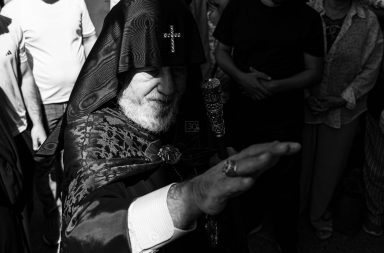
Catholicos Karekin II also cast his ballot and said he voted so that God would keep the Armenian state “unshakable” and bless the Armenian people to overcome the difficult challenges facing the nation while building a “powerful, secure, safe, law-abiding and prosperous country.”
Polling stations will remain open until 8:00 p.m., after which vote counting will begin.
8:00 a.m. Polls have opened across Armenia in the country’s parliamentary elections.
According to the Central Electoral Commission, 2,485,851 citizens are eligible to vote at 1,997 polling stations nationwide. A total of 18 political forces, including 16 parties and two alliances, are contesting the election, with 2,103 candidates on the ballot.
Eight international and 13 domestic observation missions are monitoring the vote and will also observe the counting process after polls close at 8:00 p.m.