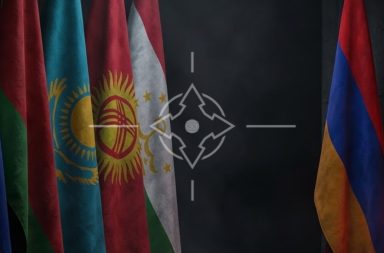
Armenia’s government has ruled out restoring its participation in the Russian-led Collective Security Treaty Organization (CSTO), even as the country faces possible expulsion from the military alliance and growing uncertainty over its future membership in the Eurasian Economic Union (EEU).
The developments raise questions about Nikol Pashinyan’s foreign policy strategy, particularly as his government continues distancing Armenia from longstanding security and economic partnerships without securing comparable alternatives.
Speaking to reporters on October 28, Foreign Minister Ararat Mirzoyan reaffirmed that Yerevan has no intention of reversing its decision to freeze participation in the CSTO.
“We will not change our position, and we do not see ourselves returning to the CSTO,” Mirzoyan declared.
His comments followed remarks by former CSTO Secretary General Nikolay Bordyuzha, who called for Armenia’s expulsion, arguing that the country continues to retain formal membership despite refusing to participate in the organization’s activities.
From the CSTO’s perspective, Armenia’s continued membership presents an institutional contradiction. The alliance operates through collective decision-making, yet Yerevan has suspended its participation, stopped paying membership contributions, and publicly rejected the organization’s relevance to Armenia’s security.
Current CSTO Secretary General Taalatbek Masadykov has indicated that Armenia’s membership could be discussed at the alliance’s November 11 summit in Moscow.
Rather than expressing concern over the possibility of Armenia losing its formal membership, Pashinyan has openly welcomed such an outcome.
“I would be very glad if the organization decided to exclude the Republic of Armenia from the CSTO,” Pashinyan told parliament in August, adding that expulsion would eliminate the need for his government to decide whether to withdraw.
Armenia formally froze its participation in the CSTO in February 2024, accusing Russia and other member states of failing to fulfill their security obligations following Azerbaijani military aggression and incursions into Armenia’s sovereign territory.
The CSTO’s response to Armenia’s security concerns has been a source of considerable disagreement between Yerevan and Moscow. While Armenian authorities maintain that the alliance did not adequately address threats to the country’s sovereignty, Russia has rejected accusations that it or other CSTO members neglected their obligations.
The dispute also reflects fundamental disagreements over the scope of the CSTO’s commitments and the circumstances under which collective defense mechanisms should be activated.
The CSTO was established as a collective security framework rather than an unconditional guarantee of military intervention in every regional confrontation. Its effectiveness depends on the political consensus and cooperation of its member states.
Armenia’s participation in the alliance also provided an established platform for military coordination, security consultations, and diplomatic engagement with several regional powers. Whether these mechanisms offered sufficient protection remains a matter of debate, but their potential loss carries strategic consequences.
This raises a broader question about Pashinyan’s approach: whether his government has adequately weighed the costs of abandoning existing security arrangements against the uncertain benefits of its proposed alternatives.
The deterioration of relations with Russian-led institutions also carries potentially significant economic consequences.
Armenia faces mounting pressure over its membership in the Eurasian Economic Union, which remains an important framework for the country’s trade and economic relations, particularly with Russia.
In May, the leaders of Russia, Belarus, Kazakhstan, and Kyrgyzstan urged Yerevan to clarify whether it intends to remain part of the EEU or continue pursuing membership in the European Union.
An October 1 report prepared by the four governments examined the potential suspension of EEU arrangements involving Armenia, underscoring growing concerns among member states about the compatibility of Yerevan’s European integration ambitions with its existing commitments.
From the perspective of EEU members, Armenia’s simultaneous pursuit of closer integration with the European Union raises questions about conflicting customs regulations, trade obligations, and economic policies.
Pashinyan dismissed the report, accusing Moscow of attempting to undermine his government.
However, his government has yet to present a clear alternative to Armenia’s existing economic integration with the EEU or demonstrate how potential disruptions to trade with Russia and other member states would be offset.
The growing confrontation highlights a central contradiction in Pashinyan’s foreign policy: while his government seeks to distance Armenia from Russian-led institutions, the country remains economically dependent on Russia and has not secured equivalent collective defense guarantees from Western partners.
Although Armenia has raised concerns about the CSTO’s past conduct, its withdrawal or potential expulsion would represent a significant strategic shift requiring a credible long-term security framework.
With Azerbaijan continuing to pose security challenges and Armenia facing an uncertain regional environment, the central question is no longer simply whether the CSTO fulfilled its obligations, but whether Pashinyan’s government has developed a viable strategy to protect Armenia’s national interests without it.