by Mkrtich Gevorkyan
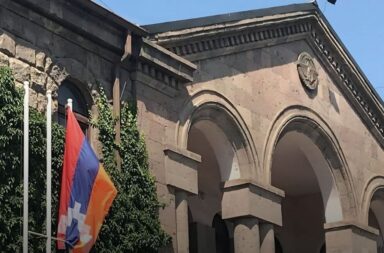
The attempt by Nikol Pashinyan to provoke a split in the Armenian Apostolic Church has led to escalating tensions centered around the historic Hovhannavank Monastery.
Defrocked former priest Stepan Asatryan has refused to leave the church or hand over its keys to the newly appointed abbot, Father Sarkis Sarkisyan. With the support of police forces, Asatryan continues to perform sacraments in the presence of pro-government activists posing as local residents. The situation has triggered deep concern within the Church and Armenian society at large.
Early Confrontations
On October 23, a couple came to the monastery to be married but, upon learning that Asatryan had been defrocked, refused to let him officiate their wedding. When clergy reminded him again that he had no right to conduct rituals, Asatryan shouted that he did not recognize the Catholicos and declared that “the Catholicos himself is defrocked,” repeating the words of Pashinyan. Pashinyan has zero legitimate authority to defrock the Catholicos of the Armenian Church, because the Church is not controlled and operated by the state. However, Pashinyan is now clearly moving in the authoritarian and anti-Christian direction of trying to control the Church.
Journalists who recorded these confrontations were forcibly expelled from the monastery. The following day, October 24, Asatryan officiated the wedding of the brother of Vladimir Vardevanyan, a member of the ruling Civil Contract party and a candidate for head of the Byureghavan community. Having sacraments conducted by defrocked priests is now apparently a badge of honor for ruling party officials.
Meanwhile, Father Sarkis Sarkisyan, the legitimate new abbot, was also detained by the Investigative Committee on October 26, the same day that Asatryan had scheduled a liturgy expected to be attended by Pashinyan himself.
The October 26 “Liturgy”
On October 26, defrocked Asatryan led a “liturgy” at Hovhannavank, attended by Prime Minister Pashinyan and senior members of the Civil Contract party. Among them were Defense Minister Suren Papikyan, Interior Minister Arpine Sargsyan, Deputy Interior Minister and Chief of Police Aram Kazaryan, Health Minister Anahit Avanesyan, Economy Minister Gevorg Papoyan, and other government officials. Regional representatives of the party were also present, including the governor of Tavush, the head of the Dilijan community, the governor of Aragatsotn, and the director of the Vazgen Sargsyan Military Institute.
Police and National Security Service forces had secured the area ahead of time, clearing parking spaces and restricting access. That same day, dozens of clergymen from the Aragatsotn Diocese, the jurisdiction of Hovhannavank, were detained for questioning by the Investigative Committee, apparently to prevent them from disrupting the event. Detaining priests is now one of the most common attacks by the Civil Contract government against human decency.
During the service, one attendee shouted that Asatryan had no right to conduct the liturgy. He was quickly silenced, removed from the church, and detained. Observers noted that one of Pashinyan’s own bodyguards was forced to stand with his back to the altar throughout the event, watching the liturgy participants. Security guards monitoring a church service is unheard of in traditional Christianity, and was not practiced even during periods of Soviet state atheism.
Political Motives and Broader Implications
Pashinyan declared that the “liturgy” at Hovhannavank symbolized the beginning of the “liberation” of the Mother See of Holy Etchmiadzin from the Catholicos of All Armenians. Pashinyan repeatedly declared his intention to “liberate” the Church…by taking it under government control. The Armenian Apostolic Church condemned the event as a direct attempt at schism, calling it a political provocation.
Analysts warn that these developments resemble the path taken in Ukraine in recent years, where a state-sponsored non-canonical church was manufactured by the government and Western patrons in order to undermine and persecute the legitimate Orthodox Church. This in Ukraine, similarly to Armenia, was used as part of a broader campaign of geopolitical transformation. The result in Ukraine is now plainly visible, with a largely destroyed country governed by an authoritarian regime that persecutes Christians. Perhaps this is what Pashinyan and his followers foresee for Armenia as well.
In Armenia and for Armenians around the world, the Armenian Apostolic Church has for centuries served as the spiritual backbone of the nation, often functioning as a substitute for the state itself during long periods without independence. Pashinyan, however, makes no secret of his disdain for Armenian history, and has even spoken of his plans to proclaim a “Fourth Republic”, implying a fundamental abolition of the current third Republic of Armenia, along with the suppression of its history and institutions. This project, aimed at transforming the foundations of Armenian identity, will require weakening the independent and canonical Armenian Church, which functions as the strongest institution of tradition in Armenian society. A regime that disdains tradition will of course disdain the Armenian Church as well. The success of this, however, will be influenced by how deeply Civil Contract partisan ideology will entrench itself among common Armenians. For now, society shows very little interest or support for Pashinyan’s campaign against the Church. Even in state-orchestrated theatrics like the illegitimate “liturgy” of October 26, participants were largely limited to Civil Contract members and affiliated activists. Nobody in Armenia other than direct employees of Pashinyan are interested in this level of desecration of Armenian tradition.
The future of this conflict will hinge on whether Armenian society chooses to defend the Church and the foundations of its identity. If Civil Contract remains in power and is allowed by Armenian society to bulldoze the ancient foundations of Armenia, the long-term consequences and damage to Armenia will be difficult to imagine.