by Davit Beglaryan
Every government relies on messaging. But when messaging replaces facts, it becomes propaganda.
For months ahead of Armenia’s 2026 parliamentary elections, Nikol Pashinyan’s government promoted claims that around 100,000 people in Russia would soon be driven to Armenia to participate in the vote and support the opposition.
The claim was echoed by government aligned activists and Armenia’s so called Foreign Intelligence Service, headed by Kristinne Grigoryan, whom Nikol Pashinyan appointed to lead the agency in October 2023.
As election day approached, the rhetoric escalated. Senior government officials publicly warned that eligible Armenian citizens arriving from Russia could be called up for 25-day military training, while reports emerged that military police were issuing notices to arrivals at Zvartnots Airport.
The message was unmistakable. A politically motivated wave of voters was supposedly on its way, and the government was prepared to respond.
It never happened.
Armenia’s own National Security Service has now dismantled that story using the government’s own data.
According to the NSS, between May 1 and June 7, 2026, arrivals from Russia using Armenian passports increased by just 3,358 compared to the same period last year. Arrivals using Russian passports increased by 28,296.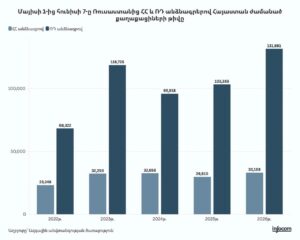
Those figures do not support the narrative the government spent months promoting.
This was not simply a failed prediction. It was a political narrative amplified by state institutions and later disproved by the state’s own statistics.
That raises a far more important question.
Why create a Foreign Intelligence Service if one of its most visible public roles is reinforcing government messaging that later collapses under the weight of official data?
An intelligence service exists to gather facts, challenge assumptions, and provide objective assessments of external threats. It is supposed to tell governments what they need to know, not help persuade the public of a political narrative.
When intelligence services become instruments of political messaging, they damage more than their own credibility. They weaken public trust in every institution responsible for national security.
Citizens become less likely to distinguish genuine threats from political campaigns. They become less likely to believe official warnings when real dangers emerge.
That is the real cost of propaganda.
The irony is difficult to ignore.
Nikol Pashinyan’s government routinely warns about foreign disinformation, influence operations, and hybrid warfare. Yet one of the most sustained information campaigns ahead of the 2026 parliamentary elections appears to have come not from a foreign adversary, but from within the Armenian government itself.
Facts have one decisive advantage over propaganda.
They can be measured.
Political narratives can be manufactured.
Official statistics cannot.
In the end, the government’s own numbers dismantled the story it spent months promoting.