A FOURTEEN-HOUR TOUR THROUGH ETHNICALLY CLEANSED ARTSAKH HAS A “STOREFRONT”, AND A LOYALTY PROGRAM
It was never just Marriott. The same package through ethnically cleansed Artsakh is retailed by Expedia, Viator, Tripadvisor, GetYourGuide, Civitatis, and AAA, all tracing to one Baku operator.
When we first traced the fourteen-hour tour, the story wore a single, famous name. You could book a drive through occupied Artsakh on Marriott’s own platform and earn Bonvoy points for the privilege. That listing did its quiet work until it was seen and, as of this writing, a direct visit to it returns “page not found.” If the exposure campaign pulled it down, that is worth marking. It is also worth being honest about its size: pulling one page from one brand does not touch the machine behind it.
Since the tour was never really Marriott’s. It belongs to a Baku ground operator Baku Heritage Tours, with a sibling trading as “Smile Azerbaijan Tour”, being fed into the plumbing of the global travel industry, where a single product is syndicated to a dozen storefronts at once. Take one down and the itinerary is still on sale everywhere else, often with the same photographs and the same carefully emptied captions.
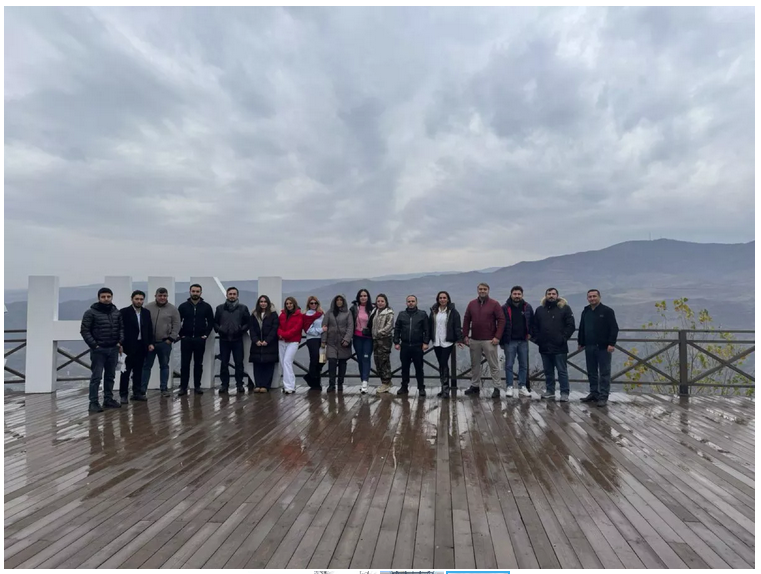
A sponsored delegation on the Jidir Duzu (“Cıdır Plain”) viewing platform above occupied Shushi , a fixed stop on the fourteen-hour itinerary now sold by Western booking platforms. (CARA/IOS dossier imagery)
Where the Same Fourteen Hours are Sold
On Expedia, Seattle-based, American, the “Shusha, Agdam and Khankendi Historical Tour” is bookable today, and the traveler earns OneKeyCash loyalty rewards for taking it. On Viator and its parent Tripadvisor, both American, the package is dressed in “trusted reviews” and “likely to sell out” urgency. On AAA’s Trip Canvas, the American Automobile Association’s own marketplace, the identical itinerary appears. In Europe, Berlin’s GetYourGuide carries the most versions of all, where several are filed, with grim irony, under a “Republic of Artsakh” location tag now used to sell the tour of that republic’s extinction. Madrid’s Civitatis sells a Karabakh day trip that speaks of “three decades of silence” without asking who fell silent.
And, behind two of the “American” storefronts sits a European one. Marriott Bonvoy Tours & Activities and AAA’s Trip Canvas are both operated by Travel Curious, a London travel-tech company. So, the neat split between U.S. and European complicity blurs at the seam: an American hotel brand’s points, running on a British company’s engine, selling an Azerbaijani state project. The permits that make it legal are pulled from Baku’s own “Yolumuz Qarabаğa” portal, the operator arranges them for you, so every booking is also a small act of recognition, an acceptance that this is Azerbaijan’s to sell.
What the Listings are Built to Omit
Read them and the technique is always the same. The land is “reborn,” “welcoming visitors after decades,” “reopening”, the passive voice of a place that supposedly emptied itself. Stepanakert is “Khankendi,” Shushi is “Shusha,” Akna is “Aghdam.” The University of “Karabakh,” built in an occupied city after its people were driven out, is a highlight. And at the tenth stop stands “We Are Our Mountains” (Papik–Tatik), the grandmother and grandfather every Armenian can picture, reduced in the copy to “regional stone art.” In none of these itineraries does the word “Armenian” appear. That is not an oversight. It is part of the plan.
What the copy will not say, the record does. In September 2023, after a nine-month blockade of food, fuel, and medicine, more than 120,000 indigenous Armenians were forced from Artsakh in a matter of days. A removal that prosecutors formerly with the International Criminal Court have assessed as genocide. Armenian hostages, among them the elected leaders of Artsakh, remain in Baku’s prisons. At least eighty people are forcibly disappeared; more than two hundred are missing, their cases uninvestigated. Churches, cross-stones, and cemeteries have been altered or erased, ancient monasteries destroyed, cultural sites erased. This is the “heritage” on the itinerary.
Why the Distributors, Not Just the Brand
The licensing defense is already rehearsed: Marriott will say its activities platform runs “under license,” Expedia and Tripadvisor that they are “marketplaces,” AAA that a partner supplies the inventory. But, the domain is theirs. The checkout is theirs. The loyalty points, Bonvoy, OneKey, are theirs, and points are not a neutral technology; they are an inducement, a reason to choose this itinerary over another. A company does not get to lend its name, its trust, and its rewards currency to the whitewashing of a crime against humanity and then file the responsibility with a subcontractor in Baku.
The “ask” is, therefore, narrow and concrete, and it is aimed at companies that answer to Western consumers and Western law. De-list the Artsakh itineraries, every variant, on every domain and subsidiary. Stop awarding loyalty points on travel through occupied, ethnically cleansed territory. And, publish the de-listing, so that a takedown is a policy and not a quiet edit that reappears next quarter under a new product code. Marriott’s vanished page shows the pressure can work. The rest of the roster shows how much is left to do.
This is the second installment following “Genocide Tourism, Occupied Artsakh, and the Fourteen-Hour Tour.” It widens the frame from one hotel brand to the distribution network carrying the same Baku-run package, and names the U.S. and European companies now selling it.
The Center for Armenian Research and Analysis (CARA) is a trans-national institute that provides investigative, analytic, and informational resources to public and private entities across the Armenian experiential spectrum.