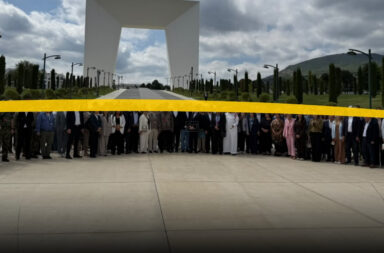
On the morning of June 5, 1919, just a few kilometers from Shushi, the destruction of an entire Armenian village began.
It was Ghaybalishen.
The villagers resisted the attacking armed groups, but Azerbaijani regular forces later joined the assault. By evening, the village had been captured. Homes were looted and burned, hundreds of residents were killed, and survivors were forced to flee.
The killings continued into the following day. A British military report recorded that Ghaybalishen lay directly below Shushi and was visible from the residence of Khosrov Bek Sultanov, the Governor-General of Karabakh and Zangezur.
Nine months later, massacre, looting, and arson would devastate Shushi’s Armenian quarters.
Ghaybalishen Before 1919
Ghaybalishen was an old Armenian settlement just outside Shushi. Its Surb Astvatsatsin Church was built in 1696, and a road leading from Shushi’s Yerevan Gate toward Khachen passed through the village. The settlement also had a cemetery, a bridge, and mills.
According to the 1897 census of the Russian Empire, 381 Armenians lived there.
The community attacked in June 1919 had centuries of history and an established place in the Armenian life of the Shushi region.
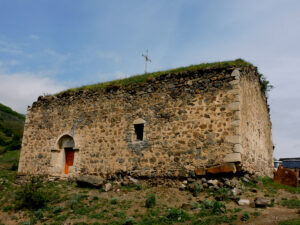
Surb Astvatsatsin Church in Ghaybalishen. Photo source: Monument Watch
Artsakh After the Collapse of the Russian Empire
Following the collapse of the Russian Empire in 1917, the South Caucasus entered a period of conflict over power and borders. Armenia and Azerbaijan declared independence in 1918, and Artsakh became one of the principal disputes between them.
But the issue was not limited to the territorial claims of the two newly established states. The Armenians of Artsakh had their own political institutions and, through a series of congresses, repeatedly rejected demands to accept Azerbaijani rule.
After World War I, British forces entered the region. In early 1919, Azerbaijani authorities appointed Khosrov Bek Sultanov Governor-General of Karabakh and Zangezur.
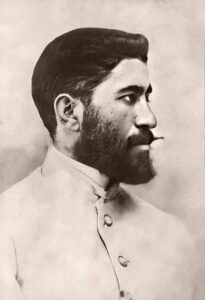
Khosrov Bek Sultanov, an Azerbaijani statesman who served as Minister of War of the Azerbaijan Democratic Republic and Governor-General of Karabakh.
Artsakh’s Armenian leadership refused to recognize his authority. Over the following months, pressure on the Armenian population intensified.
Tensions Escalate Around Shushi
By early June 1919, Azerbaijani forces were being concentrated in Shushi and in the area of present-day Stepanakert.
On June 4, armed clashes began in Shushi.
In a letter dated June 25, Bishop Vahan, head of the Artsakh Diocese, described the events to Catholicos of All Armenians Gevorg V. According to his account, Shushi had been surrounded, the Armenian population had organized self-defense, and the exchange of fire continued for around 28 hours.
He also reported that up to 40 Armenians who found themselves in the Azerbaijani-populated part of the city were captured and killed.
The attacks then spread to the Armenian villages surrounding Shushi.
Preserved in the National Archives of Armenia, Bishop Vahan’s letter provides a contemporary Armenian account of the June violence.
The Assault on Ghaybalishen
On the morning of June 5, Ghaybalishen came under attack.
According to historian Richard Hovannisian, Sultan Bek Sultanov, the brother of Khosrov Bek Sultanov, commanded an irregular force of around 2,000 mounted fighters that moved against the Armenian villages.
The armed residents of Ghaybalishen initially resisted and held the approaches to the village for part of the day. When Azerbaijani regular units joined the attackers, the balance of forces shifted.
By evening, Ghaybalishen had been captured. Residents were killed, homes were looted, and buildings were set on fire.
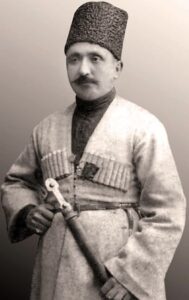
Sultan Bek Sultanov, brother of Khosrov Bek Sultanov.
What British Officers Recorded
A British military report, later published in the documentary collection Nagorno-Karabakh in 1918-1923, placed the beginning of the massacre at around 10:00 a.m. on June 5.
By June 6, the situation in Shushi had become relatively calm. In Ghaybalishen, the killings continued.
British Captain Gowans attempted to approach the village but came under fire. A bullet struck his shoulder strap. He reported hearing groans and cries from the village but was unable to provide assistance.
The report also cited information from Colonel Clutterbuck. Of Ghaybalishen’s roughly 700 residents, only 11 men and 87 women and children were known at that point to have survived.
The report explicitly allowed for the possibility that other survivors would later be found. These were preliminary findings recorded immediately after the massacre, not a final casualty count.
The Violence Spreads
In his June 25 letter, Bishop Vahan identified the attackers at Ghaybalishen as Kurdish armed groups accompanied by Azerbaijani troops. He reported that they killed much of the population before looting and burning the village.
The attacks then spread to Krkzhan, Pahlul, and Jamilu. All three villages were looted; Krkzhan and Pahlul were also burned. Many residents attempting to flee were shot.
According to the same account, by the third day the attacks had reached Karin Tak and Dashushen.
Within several days, the violence had spread across a chain of Armenian settlements surrounding Shushi.
How Many People Were Killed?
The surviving sources give different casualty estimates. They do not all cover the same settlements, and some survivor figures were recorded before a full accounting was possible.
According to the record of a commission that investigated the events, around 500 people were killed during the destruction of Ghaybalishen. The same records describe a village of around 70 homes.
Other accounts indicate that between 100 and 180 of roughly 700 residents survived. These estimates should be distinguished from the British report’s provisional count of those known to have survived immediately after the attack.
Armenian sources also cite figures of around 600 to 620 victims. Hovannisian estimates that approximately 600 Armenians were killed in Ghaybalishen and the surrounding villages.
The geographic distinction matters: the commission’s estimate concerns Ghaybalishen itself, while Hovannisian’s includes neighboring settlements. That helps explain some differences, but it does not establish a single, definitive death toll.
Who Was Responsible?
After the massacre, the British conducted an investigation.
Khosrov Bek Sultanov attempted to distance himself from the killings, but the circumstances recorded in British documents raised serious questions about his role.
Ghaybalishen was visible from his residence, the attacking forces operated within the territory under his authority, and Azerbaijani regular troops participated in the assault. Hovannisian’s account also identifies Sultanov’s brother as the commander of mounted irregulars operating against the Armenian villages.
British documents record another significant episode involving Dashushen: an order to withdraw, conveyed by a British officer, halted an advance by armed groups.
The episode raised a further question about whether intervention could have prevented the earlier bloodshed at Ghaybalishen.
The British investigation reportedly concluded that Sultanov had the means to prevent the killings.
After the Massacre
Ghaybalishen’s surviving residents were dispersed.
Later studies drawing on the 1921 census record some former residents of Ghaybalishen and Pahlul in the settlement that would be renamed Stepanakert in 1923. The consequences extended beyond the destruction of buildings: the village’s Armenian community had been displaced.
The political crisis in Artsakh also continued. Its Armenian population resisted full Azerbaijani control, but in the summer of 1919, under severe military and political pressure, Armenian representatives were forced to enter into a temporary agreement with Azerbaijani authorities pending a final decision on the territory’s status.
The agreement did not bring lasting peace.
Nine Months Later: Shushi
In March 1920, Shushi’s Armenian quarters were devastated by massacre, looting, and arson.
Homes, shops, schools, and churches were destroyed. Part of the Armenian population was killed, while others were forced to flee.
Within a matter of days, one of the region’s most important Armenian cultural, economic, and educational centers lost much of its Armenian population and built heritage.
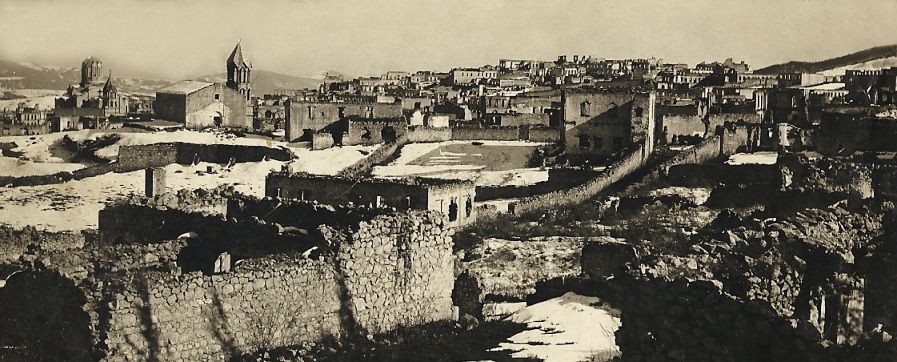
The Armenian part of Shushi after the massacres. The Holy Savior Ghazanchetsots Cathedral can be seen in the background.
The Forgotten Warning
The destruction of Ghaybalishen was recorded in British military reports, Armenian institutional records, archival correspondence, and later historical research.
Those accounts describe a village destroyed, its survivors displaced, and attacks spreading to neighboring Armenian settlements. They also show that questions about whether the killings could have been prevented were already being raised in 1919.
Ghaybalishen was a catastrophe in its own right. It was also a warning of what would follow in Shushi.
Nine months before the devastation of the city’s Armenian quarters, an Armenian community directly below it had already been destroyed.
Sources
Nagorno-Karabakh in 1918-1923: Collection of Documents and Materials, Yerevan, Publishing House of the Academy of Sciences of Armenia, 1992. Compiled by V. A. Mikaelyan, V. A. Hakobyan, O. S. Balikyan, A. S. Virabyan, and V. G. Evoyan. Digitized copy from the Fundamental Scientific Library of the National Academy of Sciences of Armenia.
Report by a representative of the British military mission on the massacres of Armenians in Shushi and surrounding villages and the role of the Governor-General.
Contemporary reports concerning the June 1919 attacks and Armenian resistance.
Records of Armenian institutions in Karabakh concerning the events of June 1919.
Letter from Bishop Vahan to Catholicos of All Armenians Gevorg V, June 25, 1919, National Archives of Armenia. Relevant excerpts were also published in an Armenpress study based on archival materials.
Materials from the commission investigating the 1919 events in Ghaybalishen, according to which around 500 people were killed during the destruction of the village. The figures are cited in Armenian historical publications.