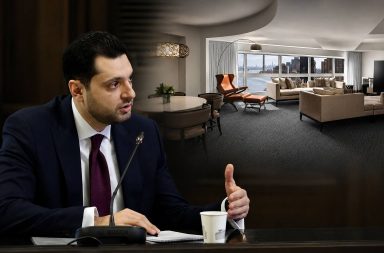
Armenia’s Anti-Corruption Court has rejected motions to terminate criminal proceedings against opposition leader Narek Karapetyan and Aleksan Aleksanyan, allowing prosecutors to pursue expanded charges against Karapetyan without renewed parliamentary authorization.
The November 11 ruling, delivered by Judge Levon Petrosyan, comes amid repeated arrests, searches and criminal investigations involving the Karapetyan family and the opposition “Strong Armenia” party, whose leadership accuses Nikol Pashinyan’s government of using state institutions to target political opponents.
Karapetyan, who leads the party’s parliamentary faction, was authorized for prosecution by the Central Electoral Commission on July 22 over accusations involving unlawful financial incentives for participation in public gatherings and particularly large-scale money laundering. The authorization did not extend to his detention.
Prosecutors subsequently expanded the case, adding Article 285 of Armenia’s Criminal Code, which concerns establishing or using a legal entity to conduct or conceal unlawful activity. They also introduced the allegation that the money laundering involved a “criminal organization.”
Defense attorney Vahe Misakyan challenged the additional accusations, arguing that prosecutors had exceeded the scope of the original authorization and were required to obtain renewed parliamentary consent.
The court rejected that argument, allowing the expanded prosecution to proceed.
At stake is the purpose of parliamentary immunity: protecting elected representatives from criminal proceedings that could be used to obstruct their political activities. The defense maintains that authorization for specific accusations cannot automatically extend to substantially different charges introduced afterward.
The prosecution centers on the “Our Way” organization, which authorities accuse of unlawfully financing political activities and providing incentives for participation in gatherings supporting “Strong Armenia.” The defense rejects the accusations and disputes the evidence supporting them.
During the November 11 hearing, prosecutors also sought approximately 26 million drams in alleged damages. Defense lawyers challenged the financial claim, questioning how the organization could be characterized as criminal while the alleged losses were calculated through corporate profit tax obligations. The court accepted the claim for procedural consideration without establishing financial liability.
Aleksanyan, a senior figure associated with “Strong Armenia,” spent nearly four months in pretrial detention before being transferred to house arrest in September.
The proceedings follow a political confrontation that began in June 2025, when businessman Samvel Karapetyan, Narek’s uncle, publicly defended the Armenian Apostolic Church and Catholicos Karekin II against Pashinyan’s attacks on its leadership.
Within hours, law enforcement officers searched his residence. He was arrested the following day on accusations of publicly calling for the unlawful seizure of power.
Pashinyan publicly threatened severe measures against those he accused of threatening the state and announced plans to nationalize Electric Networks of Armenia, the electricity distributor owned by Karapetyan’s Tashir Group.
Samvel Karapetyan’s arrest was followed by the establishment of the “Our Way” movement, which subsequently developed into the opposition “Strong Armenia” party. Criminal proceedings later extended to other figures associated with the movement.
The pressure accusations intensified in November. On November 2, Pashinyan publicly called for pressure on opposition lawmakers resisting a constitutional referendum.
Two days later, as 301 previously reported, law enforcement officers searched 65 locations, including properties linked to the Karapetyan family. Narek Karapetyan accused Pashinyan of using the operations to pressure the opposition. On November 5, the Anti-Corruption Court ordered Samvel Karapetyan detained for one month in separate proceedings.
The November 11 decision adds another element to the opposition’s accusations of political persecution. Since Samvel Karapetyan publicly challenged Pashinyan over the Armenian Apostolic Church, the family has faced arrests, repeated searches, criminal proceedings and government intervention in its business interests. The court has now permitted prosecutors to expand the case against Narek Karapetyan despite his defense’s objections concerning parliamentary immunity, before the substantive evidence has been examined. This sequence demands scrutiny of whether the powers of the state are being exercised independently or used to constrain political opposition. The prosecution’s allegations remain unproven, and no judicial finding has established political interference, but the constitutional safeguards at issue exist precisely to protect elected representatives from such risks.