The Armenian Apostolic Church is under coordinated attack from both Azerbaijani and Armenian authorities, fueling a crisis that is not only religious, but deeply political and societal.
In Azerbaijan, Grand Mufti Allahshukur Pashazadeh submitted a formal complaint to the World Council of Churches, accusing the Armenian Church of inciting conflict and calling for an international delegation to visit the region. He denied the existence of any administrative unit named “Artsakh” within Azerbaijan and asserted that “even Armenia’s Prime Minister has been forced to admit this historical fact.”
But the more serious escalation is taking place inside Armenia.
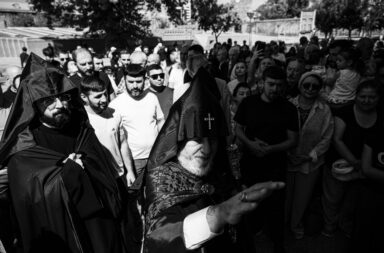
Nikol Pashinyan has launched a direct and aggressive campaign against the Armenian Apostolic Church and its spiritual leader, Catholicos Karekin II. Without presenting evidence, he has accused the Catholicos of violating his monastic vows and demanded his resignation. Pashinyan has also mocked churches as mere “storerooms” and publicly insulted clergy using vulgar language.
This assault on the Church is unfolding as a broader effort to weaken one of the last remaining institutions of national unity. The response has been swift: Church leaders, intellectuals, and tens of thousands of citizens have condemned Pashinyan’s actions as a deliberate attempt to dismantle the Church’s authority and erase a foundational pillar of Armenian identity. Protests have erupted across Yerevan, with demonstrators accusing Nikol Pashinyan of betraying Armenia’s history, weakening statehood, and sowing division.
The Supreme Spiritual Council has issued a stark warning: Pashinyan’s actions threaten not only the autonomy of the Church, but the very fabric of Armenian society.
This is no longer a religious dispute — it is a full-scale societal confrontation. The government is actively working to sever the Church’s historic role in Armenian life, replacing centuries of tradition with a model of centralized, unchallenged political control.