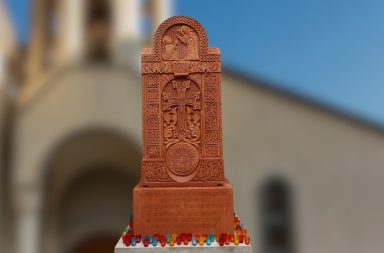
Azerbaijan has again attempted to rewrite the Armenian history of occupied Artsakh, claiming centuries-old khachkars (cross-stones) at Dadivank Monastery were recently manufactured and artificially aged with vinegar. Armenian heritage watchdog Monument Watch rejected the allegations, citing historical records that predate Artsakh’s independence.
The claims surfaced during a September 12 visit to Dadivank and Gandzasar by 150 diplomats and representatives of 58 countries and nine organizations. The Azerbaijani-organized delegation was accompanied by presidential aide Hikmet Hajiyev, who presented the Armenian monasteries as part of so-called Caucasian Albanian heritage.
At Dadivank, an Azerbaijani presenter alleged that khachkars built into the walls of the monastery’s smaller domed church were produced in a Karvachar workshop during Artsakh’s independence and treated with vinegar to appear old. He argued their condition was inconsistent with centuries of harsh winters.
Monument Watch cited seven khachkars bearing inscriptions dated between 1172 and 1190. Two inscriptions were recorded in 1911 and published in 1938; others were documented in the 1960s and published in 1982. These records contradict claims that the stones were recently made. The watchdog added that medieval builders often reused older khachkars and that durable basalt helps explain their preservation.
This is far from the first such attempt. Azerbaijani authorities have repeatedly sought to reclassify Armenian churches, monasteries and inscriptions across occupied Artsakh as Caucasian Albanian, despite historical evidence of their Armenian origins. The latest claims repeat a pattern of presenting distortions to international delegations.
Monument Watch warned that this campaign seeks to erase Artsakh’s Armenian cultural identity, particularly following Azerbaijan’s 2023 military takeover and the forced displacement of the region’s Armenian population.