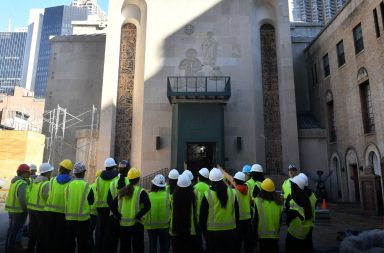
Just steps from Republic Square, on Yerevan’s Amiryan Street, stands one of the city’s surviving 19th-century educational landmarks: the former St. Hripsime Girls’ Gymnasium. Once a prominent institution for women’s education, the historic building has spent nearly three decades largely unused despite its architectural and cultural significance.
The institution was founded on January 2, 1850, by the Yerevan branch of the St. Nina Women’s Charitable Society, established in Tbilisi in 1846 through the initiative of Yelizaveta Vorontsova, wife of the Russian Empire’s Viceroy of the Caucasus. The organization supported girls’ education across the region, establishing schools in several cities.
Originally opened as a girls’ school, the institution became a progymnasium in 1884 and received full gymnasium status in 1898. By the 1917–1918 academic year, it enrolled 526 students, including 352 Armenians.
Students studied languages, religion, geography, mathematics, history, arts and handicrafts. Instruction was primarily conducted in Russian, while Armenian was not initially a compulsory subject. Annual tuition and boarding fees of 50–100 rubles made education largely accessible to girls from wealthier families.
The surviving building took shape during the late 19th and early 20th centuries. Engineer Ivan Vagapov contributed to its early construction, while architect Vasily Mirzoyan oversaw subsequent development, including an expansion in 1905. Its imposing stone architecture, arched windows, distinctive roof and spacious inner courtyard preserve elements of Yerevan’s historic urban character.
Following Armenia’s independence in 1918, the institution was nationalized, renamed the Armenian Girls’ Gymnasium, and Armenian became the language of instruction. Between 1918 and 1920, part of the building also housed the First Republic’s Ministry of Public Welfare and Labor.
Under Soviet rule, the institution became a coeducational school in 1921 and was named after Alexander Myasnikyan in 1925. The building subsequently accommodated several educational and cultural institutions, including the Valery Brusov Pedagogical Institute.
In 1982, the building was designated for the Yerevan History Museum. Although the museum’s collections were eventually transferred there in 1994, exhibitions never opened. The property was sold to a private company in 1995 and fell out of use by 1997.
In 2004, the former gymnasium was officially included in Armenia’s state register of historical and cultural monuments. Nevertheless, its protected status did not prevent decades of neglect.
Renovation work in late 2024 raised new concerns after exterior alterations were carried out without the required prior approvals. Although subsequent authorization was reported in 2025, questions remained about the building’s future use and long-term preservation.
Having survived the Russian imperial era, Armenia’s First Republic, Soviet rule and independence, the former Hripsimyan Gymnasium remains a tangible connection to Yerevan’s past. Its preservation represents an opportunity not only to protect a historic building, but also to restore an important part of the city’s cultural identity.