by Gevorg Vahramyan
More often than not, we are exposed to pieces of information with topics of which we are not familiar, and which seem to be fascinating discoveries, revealing themselves as hidden gems. We, then, automatically think that the rareness and the unconventional yet convincing nature of those pieces of information make it trustworthy, driving us, sometimes, to share it with others. However, this is where the trap is. With such uncertainty and unconventionality, we risk being exposed to, and disseminating information, the levels of absurdity of which are not even remotely comprehensible to us. This absurdity disguises itself as the unconventional part of the information, reinforcing its attractiveness and luring towards it the oblivious masses. This vicious cycle reinforces the omnipresence of disinformation, or sometimes even worse, turns misinformation into disinformation…
A prime example of this are the campaigns about the myth of “Western Azerbaijan”.
In recent years, the Republic of Azerbaijan (hereafter referred to as Azerbaijan) has launched a campaign centred around the concept of “Western Azerbaijan”. This campaign is backed by the Western Azerbaijan Community, which, inspired by President Ilham Aliyev’s “Concept of Return” proposal, has even an entire platform named “Virtual Western Azerbaijan”, and even a YouTube channel which encapsulates encyclopedic information about “the ancient Oghuz-Turk homeland of Western Azerbaijan and aims to provide visitors with comprehensive and scholarly information incorporating historical and scientific significance related to this region”.
The problem with this lies in its very essence. “Western Azerbaijan”, a seemingly innocent description of a part of the country, in reality, not only it is not a description of the western part of Azerbaijan, it refers to an entire sovereign independent country, located west of Azerbaijan. In other words, the whole concept of “Western Azerbaijan” is a baseless claim, that targets the sovereignty and autonomy of the Republic of Armenia, fueled with entirely made up encyclopedias and visual stimuli to reinforce this claim. Recently leaked documents (Canbäck, Rasmus, 2025) prove that Azerbaijan’s Presidential Administration has coordinated and funded the international rollout of the ‘Western Azerbaijan’ narrative, a campaign that, while framed as humanitarian, lays the groundwork for potential irredentist claims on Armenian territory. This narrative constitutes a full-scale, government-backed disinformation campaign, contradicting not only the millenia-long presence of Armenia and the Armenian people, as well as the declaration of independence of the Republic of Armenia, but also the United Nations recognition itself. If this was not enough, the Azerbaijan authorities have begun calling their own country Northern Azerbaijan, in order to assert ownership over the Iranian province of Azerbaijan, naming it “Southern Azerbaijan”…
How to identify/find it?
(1) Official bigger-scale sources, (2) Independent sources, and (3) Insider sources.
(1) In the article “The EU and Azerbaijan: Time to Talk Tough” by Carnegie Europe, the author states that “Aliyev has also started to use the irredentist term “Western Azerbaijan” to describe Armenia”.
(2) Moreover, on a more local scale, Open Caucasus Media (OC Media), an independent journalistic newsletter publishing the latest news in the Caucasus region, obtained leaked documents, showing that the discourse is closely coordinated and supported by the Presidential Administration of Azerbaijan, despite being fronted by the Western Azerbaijan Community (WAC). For the record, the President of Azerbaijan, Ilham Aliyev, who not only inherited the throne from his father but has been holding office, with his wife as the Vice-President, for the last 22 years.
(3) Besides, even a local Azerbaijani visiting scholar at Paris Institute of Political Studies and expert on the Azerbaijani civic space, Altay Goyushov, has claimed “The Azerbaijani government seeks to keep nationalist fervor constantly alive”. It is also found, as mentioned above, with their own website, YouTube channel, and roughly any Azerbaijani government-backed newsletter and media outlet…
What bias(es) are exploited?
In order to achieve the most well-rounded fact-checking guide and the closest number of biases exploited in the given case, one would have to consult the Cognitive Bias Codex (see Image 1).
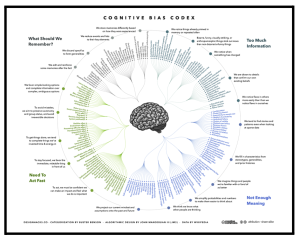
Image 1
Given the context, I personally found relevant the biases from the “Need to Act Fast” part’s following subparts:
1. “To stay focused we favor the immediate”
2. “We favor simple looking options and complete information over complex, ambiguous options”.
“To stay focused we favor the immediate”
From this subparts, the (A) “Identifiable victim effect” bias and the (B) “Appeal to novelty” fallacy would best describe the cognitive inclination to believe this campaign.
A. Identifiable victim effect describes how individuals tend to offer more assistance to victims they can identify with than to those who are vague or abstract (Zhao et al.). To someone who does not know about the truth, Azerbaijan is the identifiable victim in this case, whose territories of the imaginary “West Azerbaijan”, according to their mass propaganda campaign and distorted historical encyclopedias, are “occupied” by the Republic of Armenia.
B. Appeal to novelty fallacy, on the other hand, is an error in reasoning, that is based on the assumption that new things are necessarily good or better (Fallacy in Logic). In this case, this full-scale baseless disinformation campaign is a novelty, which seems to appeal to the human brain. This argument is further proven by the fact that this fallacy is arguably a common one in many domains, such as politics, fashion, and technology industries (Fallacy in Logic).
From the subpart “We favor simple looking options and complete information over complex, ambiguous options”, the most relevant biases would be:
(A) “Occam’s razor”, (B) the Conjunction fallacy, the (C) Belief Bias, the (D) Information Bias, and the (E) Ambiguity Bias.
A. Occam’s razor is the principle that, all else being equal, simpler explanations should be preferred over more complex ones (Piasini et al.). This makes sense in the given context, since it is easier to believe their simplified seemingly fact-based explanations and the made up narrative, rather than go over the complex history, territorial disputes and the presence of ethnic groups in the region. Otherwise, if one knows nothing about Armenia’s millenia-long history and ethnic presence, as well as its territorial integrity, none of which are sadly considered common sense, it is very likely that they would fall into the trap of Azerbaijan’s state-backed absurd narrative and believe the insane claims regarding “Western Azerbaijan”…
B. The Conjunction fallacy occurs when one estimates a conjunctive statement (this and that) to be more probable than at least one of its component statements (Conjunction Fallacy). Given that the Azerbaijan government has approved and financed the WAC, which now has as its basis the conjunction of encyclopedias, the YouTube channel, as well as the entire platform and the website, it is more probable to be perceived as the truth to someone who possessed very little to no knowledge of the region and its history.
C. Belief bias can influence decision-making by leading someone to a believable but invalid conclusion or leading someone to reject a valid but unbelievable conclusion (“Belief Bias”). The whole “Western Azerbaijan” campaign is based on this bias, fueled by the oblivion of the masses. They use authority to make their false statements very believable hence leading people to invalid conclusions, which can easily make them reject valid but unbelievable, to them, conclusions.
D. Information bias occurs when people seek out information that supports their existing beliefs (Dovetail Editorial Team). To those already exposed to such propaganda before, it is their “prior knowledge” that will lead them to believe this information. Just like the snowball effect, once this information is successfully insinuated, it is easier to then reinforce it and brainwash people to believe it, given that they have heard about it before and that it supports their existing beliefs.
E. The ambiguity effect is a cognitive bias where decision making is biased by a lack of information (ambiguity) (Dovetail Editorial Team, What Is Information Bias? Overview, Examples, and Ways to Avoid). In this case, the decision-making is about taking a side and/or deciding to believe the myth of “Western Azerbaijan”, given that people are either completely unaware or ambiguously aware of the history and the geography of the region. This ambiguity makes them incline towards this information, given all the biases mentioned above.
All in all, debunking the myth of “Western Azerbaijan” requires intensive cognitive efforts in order to identify our inherent inclinations. This case is a prime instance proving how uncovering the truth requires going against at least all 7 inherent human biases and fallacies, namely the “Identifiable victim effect” bias, the “Appeal to novelty” fallacy, the “Occam’s razor”, the Conjunction fallacy, Belief bias, Information bias, and the Ambiguity bias, while considering their respective causes and consequences. Given the amount of information and research on cognition available online, as well as basic proofs such as historical maps, such campaigns must be immediately fact-checked, disqualified and deleted, in order to counter the dissemination of and diminish the omnipresence of one of the most dangerous types of disinformation — the political
disinformation.
About the author
A graduate of the Anania Shirakatsy Lyceum, Gevorg is a King Constantine II medalist, awarded for his leadership and representation of Armenia on the global Round Square stage. Currently an undergraduate student at Sciences Po (Paris Institute of Political Studies), Gevorg is an Émile Boutmy scholarship awardee — an entirely merit-based scholarship reserved for “the very best international students from outside the European Union who demonstrate academic excellence”, named after the founder of the university.
He has organized Sciences Po’s first-ever conference dedicated to Artsakh, featuring the Official Representative of the Republic of Artsakh in France, Hovhannes Guevorkian, as one of the two keynote speakers. By shooting a short film about the 110th anniversary of the Armenian Genocide, as well as authoring articles and organizing conferences about Artsakh, Gevorg actively raises awareness about Armenia and Artsakh, and he aspires to pursue a career that will enable him to continue doing so on the international stage.
Bibliography
“Belief Bias.” Newristics, newristics.com/heuristics-biases/belief-bias.
“Bikeshedding – the Decision Lab.” The Decision Lab, thedecisionlab.com/biases/bikeshedding.
Canbäck, Rasmus. “EXCLUSIVE: Azerbaijan’s ‘Western Azerbaijan’ Campaign Exposed in Leaked Documents.” OC Media, 3 Nov. 2025,
oc-media.org/exclusive-azerbaijans-western-azerbaijan-campaign-exposed-in-leaked-documents.
Conjunction Fallacy. www.logicallyfallacious.com/logicalfallacies/Conjunction-Fallacy.
Dovetail Editorial Team. What Is Information Bias? Overview, Examples, and Ways to Avoid.
19 Nov. 2023, dovetail.com/research/what-is-information-bias.
—. What Is Information Bias? Overview, Examples, and Ways to Avoid. 19 Nov. 2023, dovetail.com/research/what-is-information-bias.
Fallacy in Logic. “What Is the Appeal to Novelty Fallacy? Definition and Examples.” Medium, 4 Apr. 2021,
fallacyinlogic.medium.com/what-is-the-appeal-to-novelty-fallacy-definition-and-exa mples-5f227432acc5.
Galichian, Rouben and Yerevan. The NEW TERMINOLOGY of “WESTERN AZERBAIJAN.” monumentwatch.org/wp-content/uploads/2023/12/Western-Azerbaijan.pdf.
Piasini, Eugenio, et al. “How Occam’s Razor Guides Human Decision-making.” bioRxiv
(Cold Spring Harbor Laboratory), Jan. 2023,
https://doi.org/10.1101/2023.01.10.523479.
Suny, et al. “Armenia | Geography, Population, Map, Religion, and History.” Encyclopedia Britannica, 23 Oct. 2025, www.britannica.com/place/Armenia.
Thomas de Waal. “The EU and Azerbaijan: Time to Talk Tough.” Carnegie Endowment for
International Peace,
carnegieendowment.org/europe/strategic-europe/2023/09/the-eu-and-azerbaijan-time-t
o-talk-tough?lang=en&ref=oc-media.org.
Virtual Western Azerbaijan. qerbiazerbaycan.com/en/?ref=oc-media.org.
Zhao, Hailing, et al. “The Neural Mechanisms of Identifiable Victim Effect in Prosocial
Decision‐making.” Human Brain Mapping, vol. 45, no. 2, Feb. 2024, p. e26609.
https://doi.org/10.1002/hbm.26609.