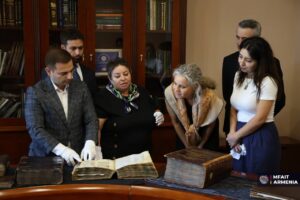
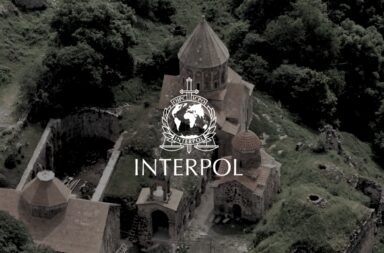
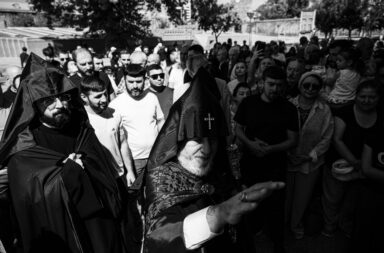
Representatives of Azerbaijan’s Albanian-Udi religious community held prayers and religious rites at Gandzasar Monastery in Artsakh on September 21, as Azerbaijani media again presented the medieval Armenian monastery as part of “Albanian Christian heritage.”
Gandzasar was built in the 13th century under Armenian prince Hasan Jalal-Dawla of the Hasan-Jalalyan dynasty. Its main church, completed in 1238, bears Armenian inscriptions documenting its construction and served for centuries as one of Artsakh’s most important Armenian religious centers.
During the visit, representatives of the Albanian-Udi community called Gandzasar part of Caucasian Albanian heritage, with community head Robert Mobili claiming that churches in territories now controlled by Azerbaijan were Albanian and that Azerbaijan was the “sole heir” to that heritage.
The visit follows a tour organized earlier this month by Azerbaijani presidential aide Hikmet Hajiyev for foreign diplomats, during which Gandzasar and Dadivank were likewise presented as “Caucasian Albanian.” Azerbaijani officials have also sought to recast the Hasan-Jalalyan dynasty itself as Albanian rather than Armenian.
The claims form part of a broader pattern documented by Caucasus Heritage Watch, which says Azerbaijani authorities have pursued an extensive campaign to portray Armenian heritage sites as either nonexistent or “Caucasian Albanian,” while Armenian inscriptions and imagery have also faced removal or destruction.
The same organization has documented the destruction of 108 Armenian monasteries, churches and cemeteries in Nakhchivan between 1997 and 2011, describing the findings as evidence of systematic cultural erasure.
At Gandzasar, that rewriting now extends beyond how the monastery is described: Azerbaijani-backed religious representatives are conducting services inside a medieval Armenian monastery while its Armenian history is being recast as something else.
RELATED

Hajiyev Presents Blank Museum Reproduction as ‘Evidence’ of Armenian Falsification at Gandzasar in Occupied Artsakh
Mother See Condemns Azerbaijan’s Attempt to Rebrand Armenian Monasteries in Occupied Artsakh